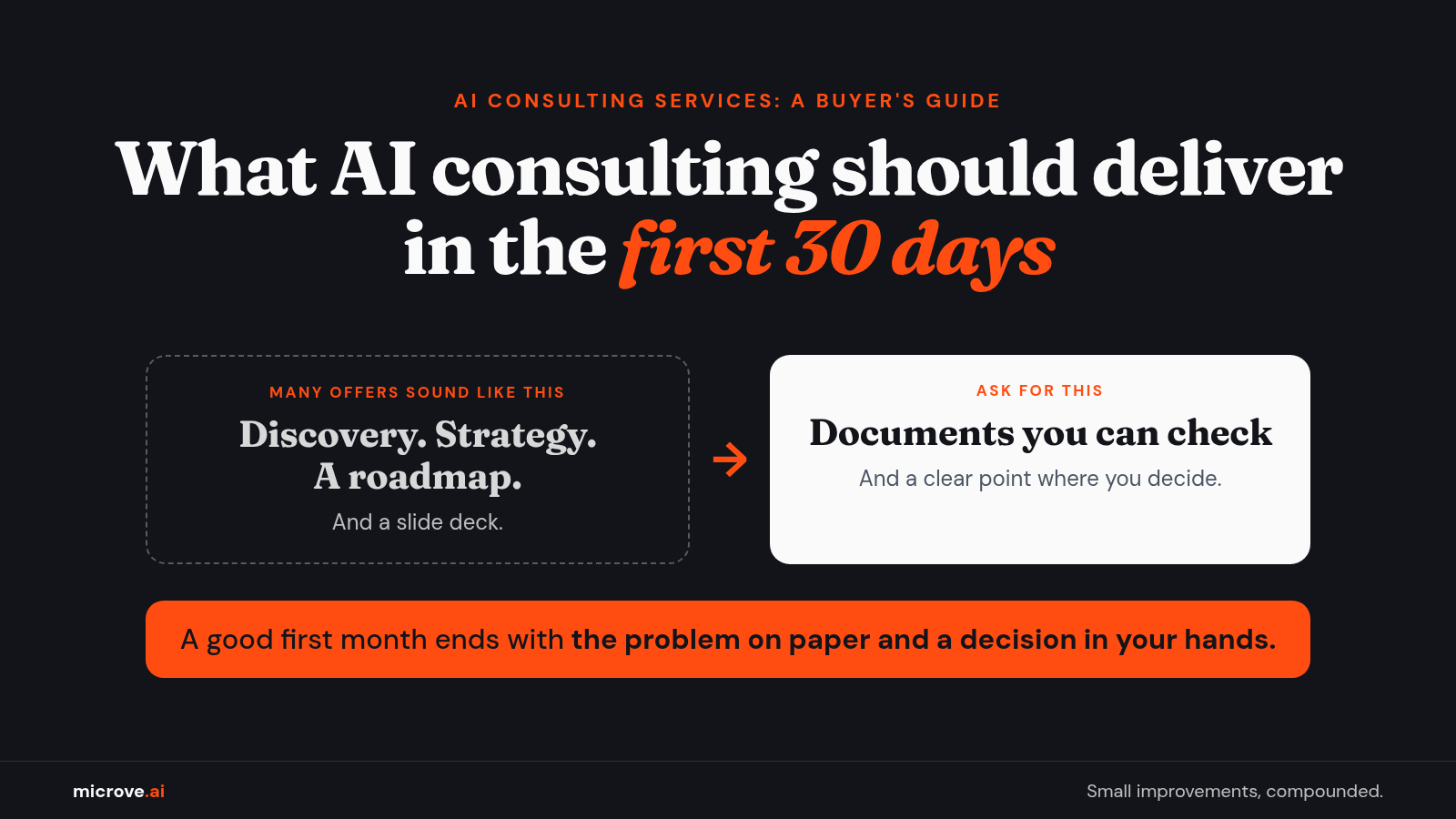
What AI consulting should deliver in the first 30 days
If you are comparing AI consulting services, many offers sound the same. Discovery. Strategy. A roadmap.
The first month should give you more than a slide deck. It should give you documents you can check, and a clear point where you decide.
Here is what to look for, whoever you hire.
Why the first month matters
No single U.S. law or standard spells out what an AI consulting engagement must deliver. So the buyer sets the bar.
A useful neutral reference is the NIST AI Risk Management Framework (January 2023). It is voluntary. It says the purpose, users and setting of an AI system should be "understood and documented," and that "the business value or context of business use has been clearly defined."
Put simply: before anyone builds, the problem should be on paper.
The first 30 days, phase by phase
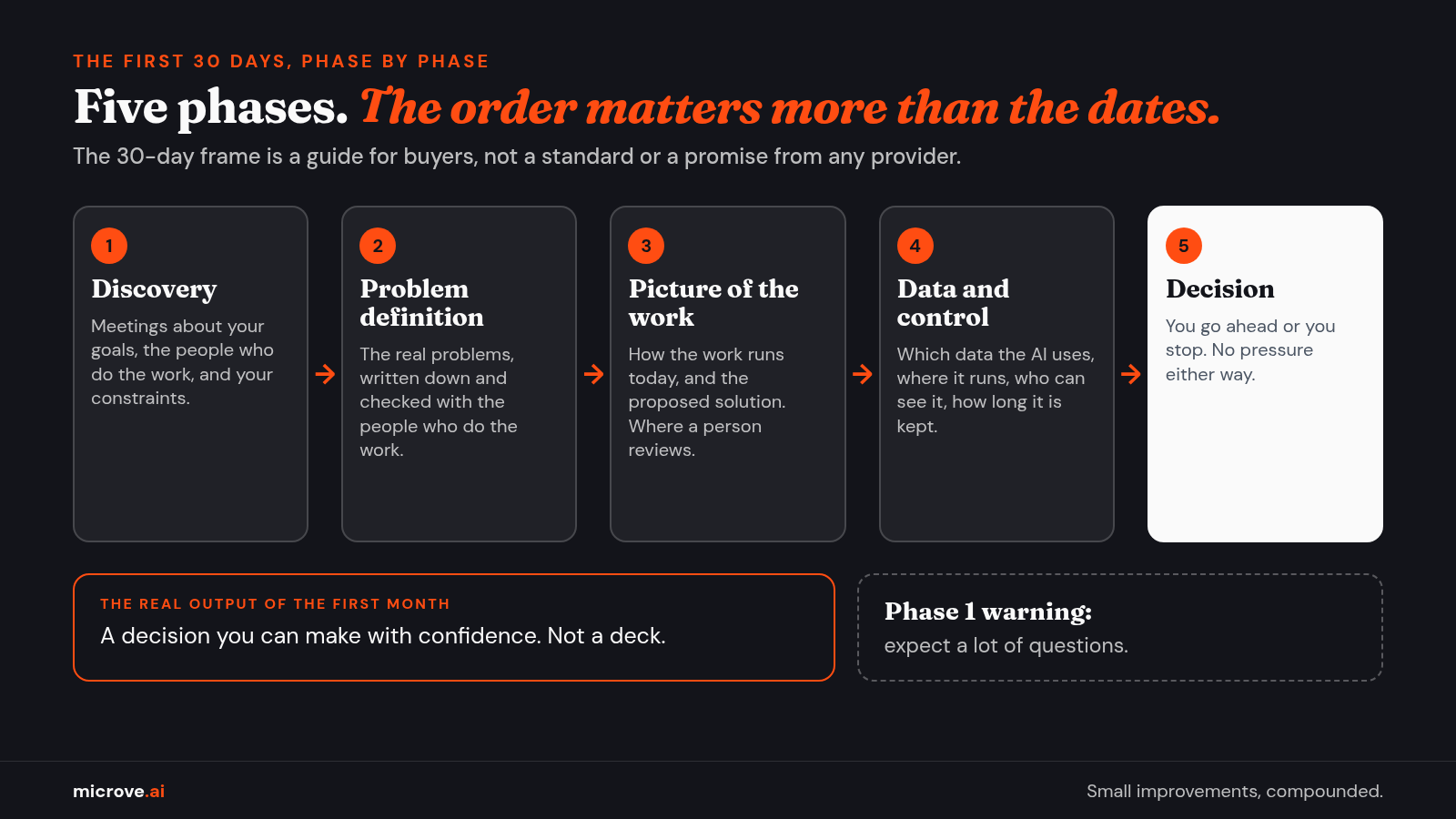
The 30-day frame is a guide for buyers, not a standard or a promise from any provider. Real timing depends on the provider and the scope. The order matters more than the dates.
- Discovery. Meetings about your goals, the people who do the work, and your constraints. Expect a lot of questions.
- Problem definition. A written list of the real problems, checked with the people who do the work every day.
- Picture of the work. A simple map of how the work runs today, and of the proposed solution. It should show where a person reviews the output.
- Data and control. A written answer on which data the AI uses, where it runs, who can see it and how long it is kept.
- Decision. You go ahead or you stop. With no pressure either way.
NIST notes that after this kind of mapping, a buyer should know enough "to inform an initial go/no-go decision." That is the real output of the first month: a decision you can make with confidence.
What to ask for in writing
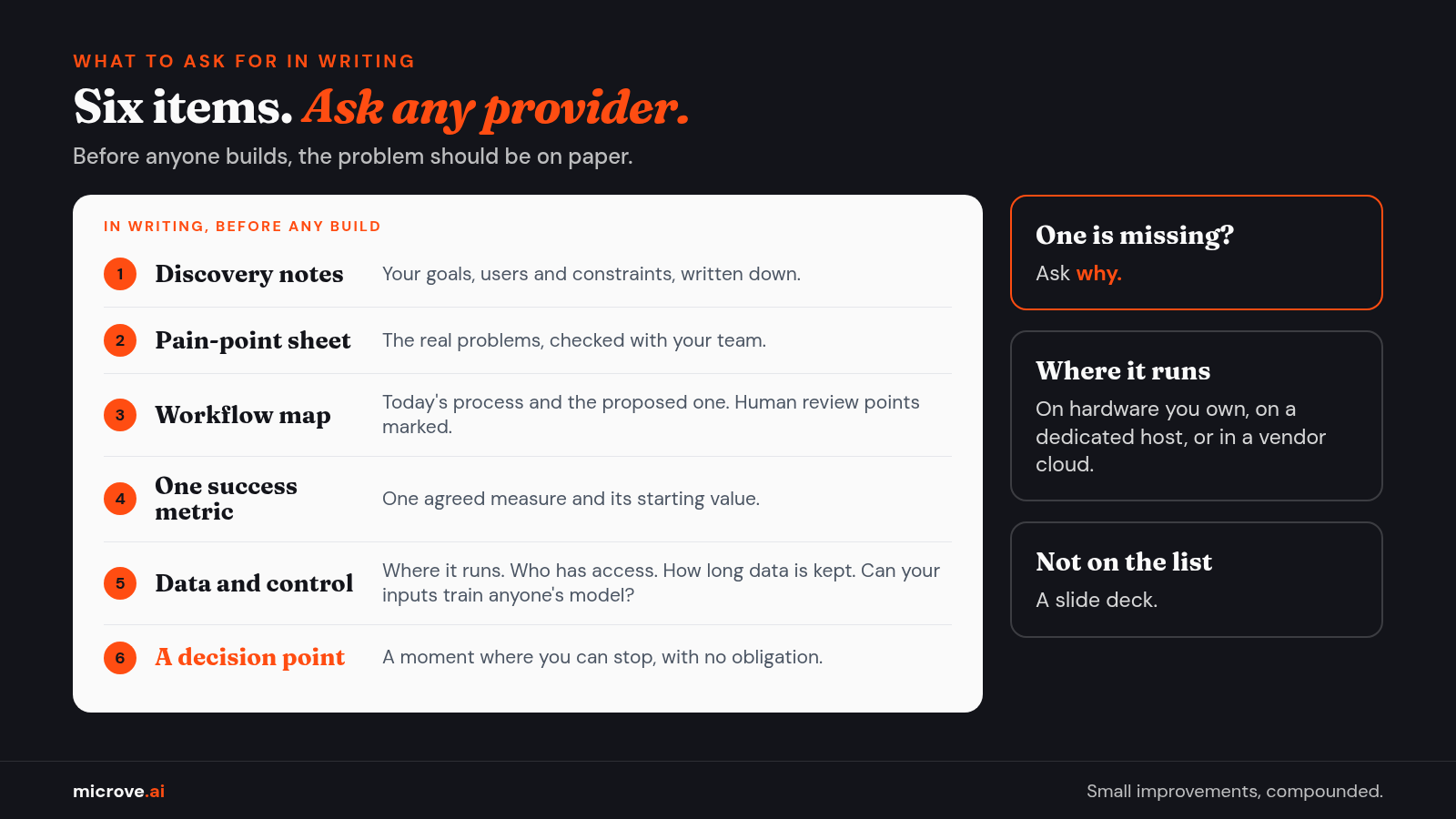
Ask any provider for these six items. If one is missing, ask why.
- Discovery notes. Your goals, users and constraints, written down.
- A pain-point sheet. The real problems, checked with your team.
- A workflow map. Today's process and the proposed one, with human review points marked. The SBA advises having "another person review all AI products."
- One success metric. One agreed measure and its starting value, before any build. Federal buying guidance (OMB M-25-22, April 2025) asks agencies to define metrics and assess vendor claims before contract award. It binds federal agencies only, but it is a good model.
- A data and control decision. Where data and models run: on hardware you own, on a dedicated host, or in a vendor cloud. Who has access. How long data is kept. Whether your inputs can train anyone's model.
- A clear decision point. A moment where you can stop, with no obligation.
Questions that sort serious providers from the rest
- What is your evidence? The FTC requires "competent and reliable evidence" for AI accuracy claims "at the time it is made" (Workado order, August 2025). Ask for it before you accept any time-saved or savings number.
- Which outside services are in the system? Every outside model or cloud service brings its own terms.
- Healthcare: who signs a business associate agreement? HHS says a cloud provider that stores electronic patient data is a business associate and needs one.
- Law firms: how does this fit our duties? ABA Formal Opinion 512 (July 2024) covers confidentiality and supervision when lawyers use generative AI.
- What do we own at the end? Ask how you leave, and what comes with you.
This article is general information, not legal advice. For HIPAA, bar rules or other legal questions, talk to your own attorney or compliance advisor.
How Microve runs the first phase
We are not a strategy firm. We build working tools.
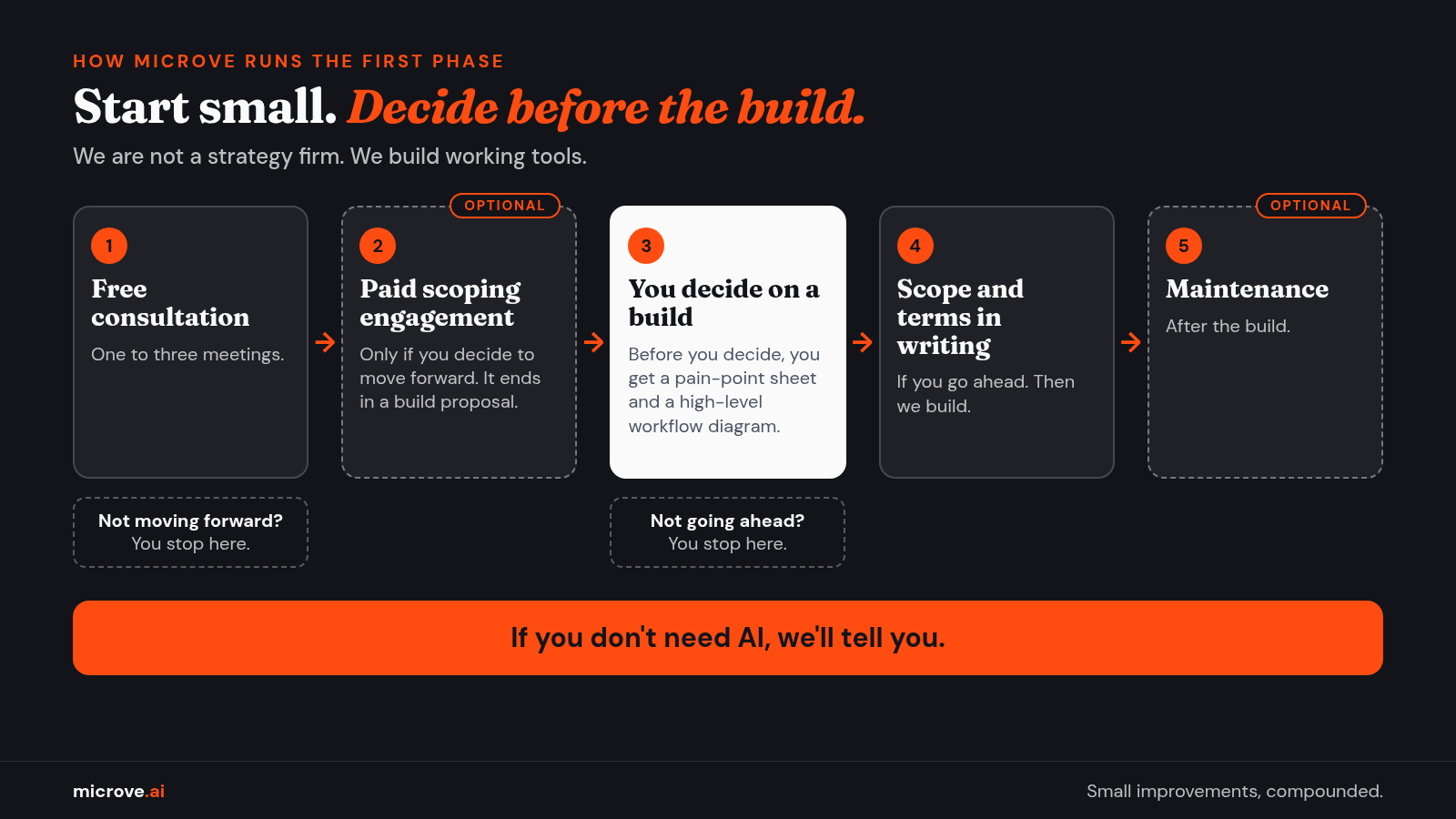
Microve starts with a free consultation of one to three meetings. If you decide to move forward, an optional paid scoping engagement follows. It ends in a build proposal.
Before you decide on a build, you get a pain-point sheet and a high-level workflow diagram of the solution. If you go ahead, scope and terms are in writing. Then we build. Maintenance after that is optional.
If you don't need AI, we'll tell you.
The bottom line
A good first month ends with the problem on paper and a decision in your hands. Not a deck.