HIPAA Compliant AI: Sign the BAA Before the Pilot
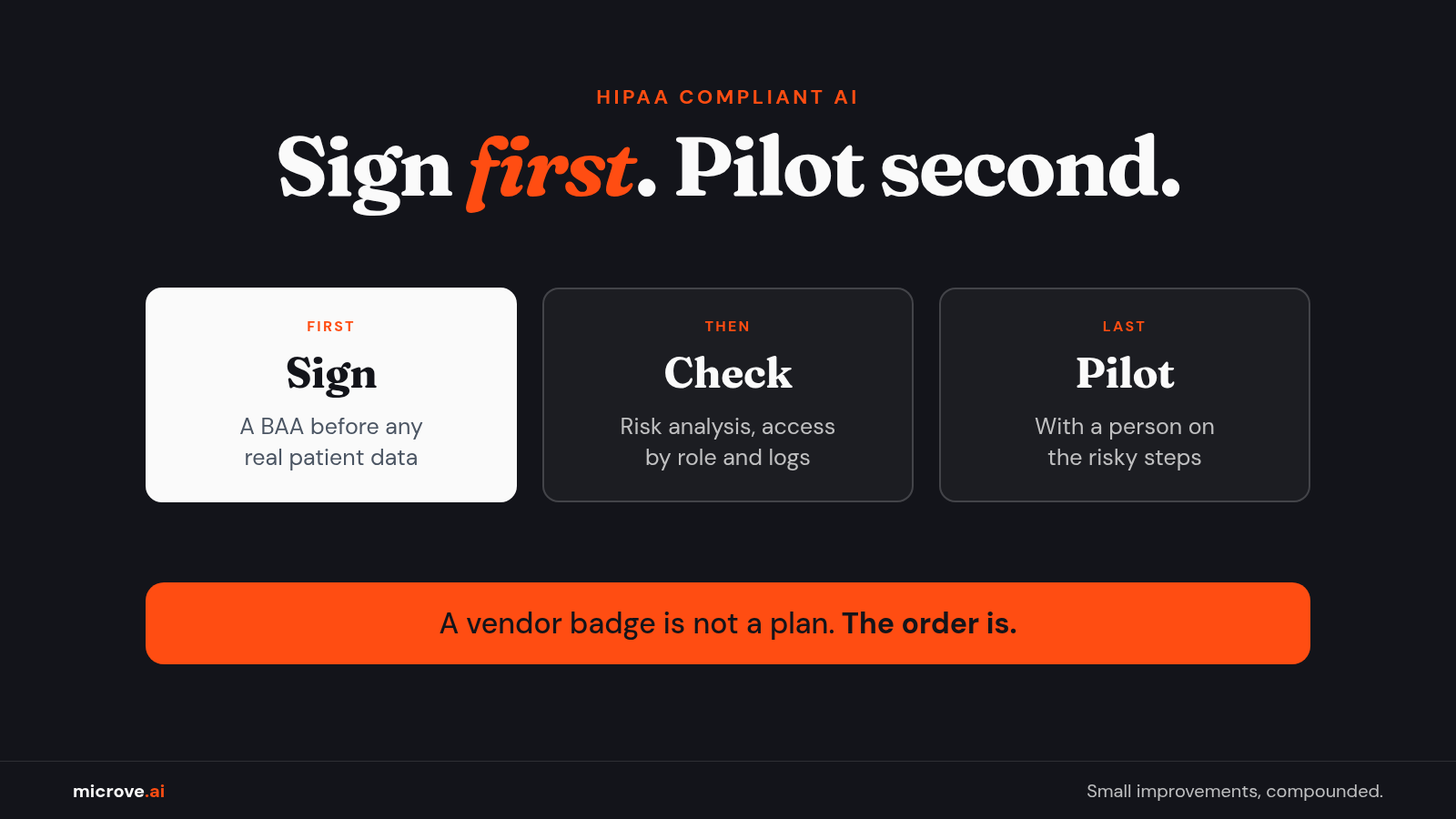
A vendor badge is not a plan. Here is what must line up before patient data, or other sensitive data, meets a new AI tool.
A dental office wants an AI assistant for patient messages. It answers questions, sends reminders and books appointments. The demo is great. The vendor's website says "HIPAA compliant" in a very confident font.
Then the office manager asks: can we try it on real patient messages this week?
Not yet. The contract comes first. The pilot comes second.
Healthcare is the example here because its rules are written down in detail. The same order works for a law firm with client files, an accounting firm with tax records, or an HR team with employee files. The rule names change. The order does not.
This article is educational, not legal advice. Talk to your counsel before sensitive data goes into any new tool.
Five terms in plain English
- HIPAA is the U.S. federal law from 1996 behind the national rules for protecting health information. The HHS summary of the Privacy Rule (U.S. Department of Health and Human Services) explains who it covers.
- A covered entity is a health plan, a health care clearinghouse (a company that converts health billing data between nonstandard and standard formats), or a health care provider that sends certain transactions electronically, such as insurance claims. A dental office that files claims online is one.
- PHI (protected health information) is health information that can be tied to a person. It covers a condition, the care someone gets, or payment for that care. A patient's name next to "crown follow-up, Tuesday 3 PM" is PHI.
- A business associate is a person or company that creates, receives, stores or sends PHI on behalf of a covered entity. Think billing services, cloud storage, transcription, or an AI tool that reads patient messages for the practice.
- A BAA (business associate agreement) is the written contract in which the business associate promises to safeguard the PHI and use it only as the contract allows.
Why "HIPAA compliant" is not a sticker
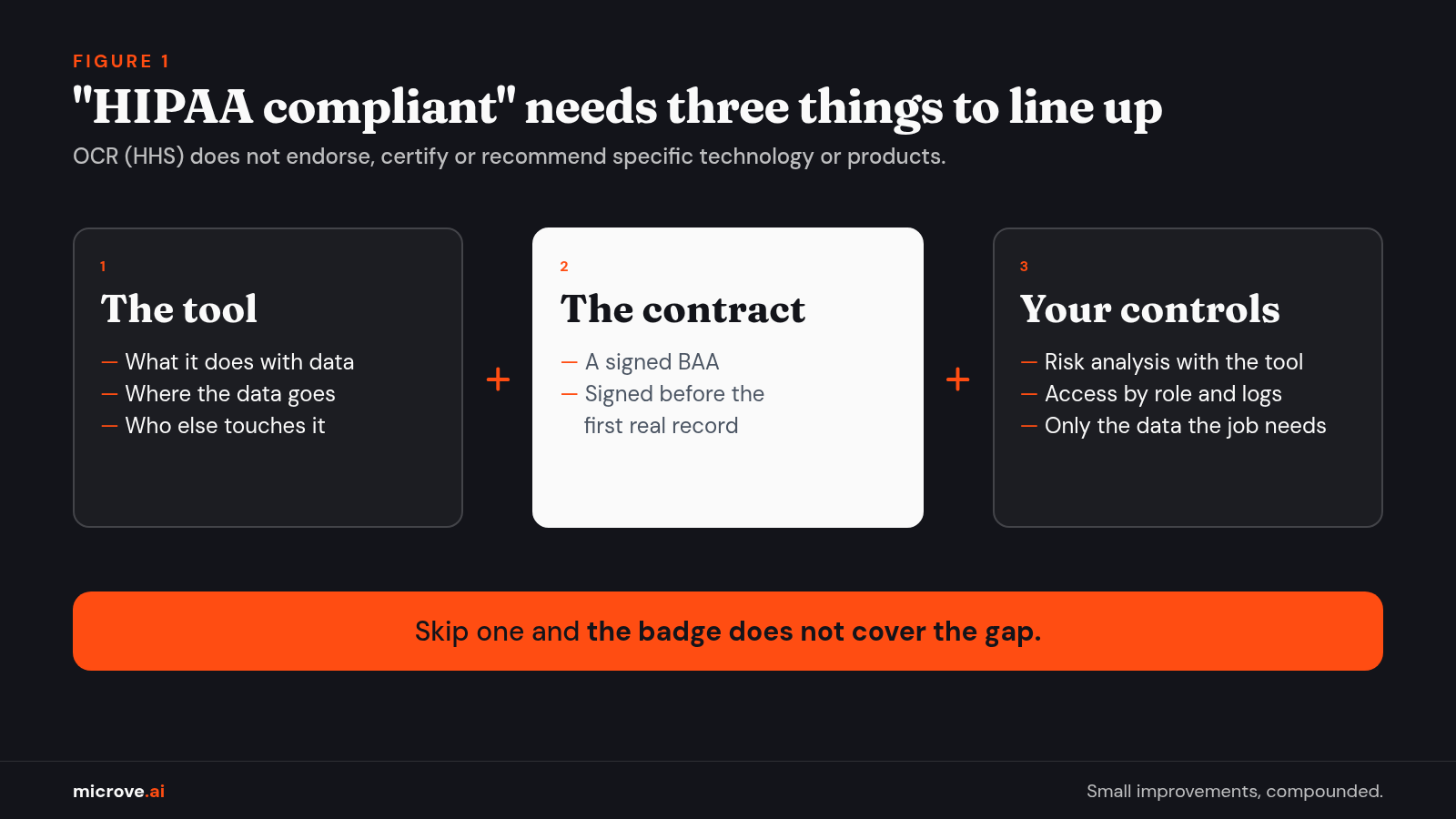
In its guidance on HIPAA and cloud computing, the HHS Office for Civil Rights (OCR, the office that enforces HIPAA) says it "does not endorse, certify, or recommend specific technology or products."
So a badge on a vendor page is the vendor describing itself. It can be a useful start. It is not an inspection.
Whether your use of the tool is in line with the rules depends on three things lining up:
- The tool. What it does with the data, where the data goes, and who else touches it.
- The contract. A signed BAA before the first real record goes in.
- Your controls. A risk analysis that includes the tool, access by role, logs, and sending only the data the job needs.
Skip one and the badge does not cover the gap.
When an AI vendor needs a BAA
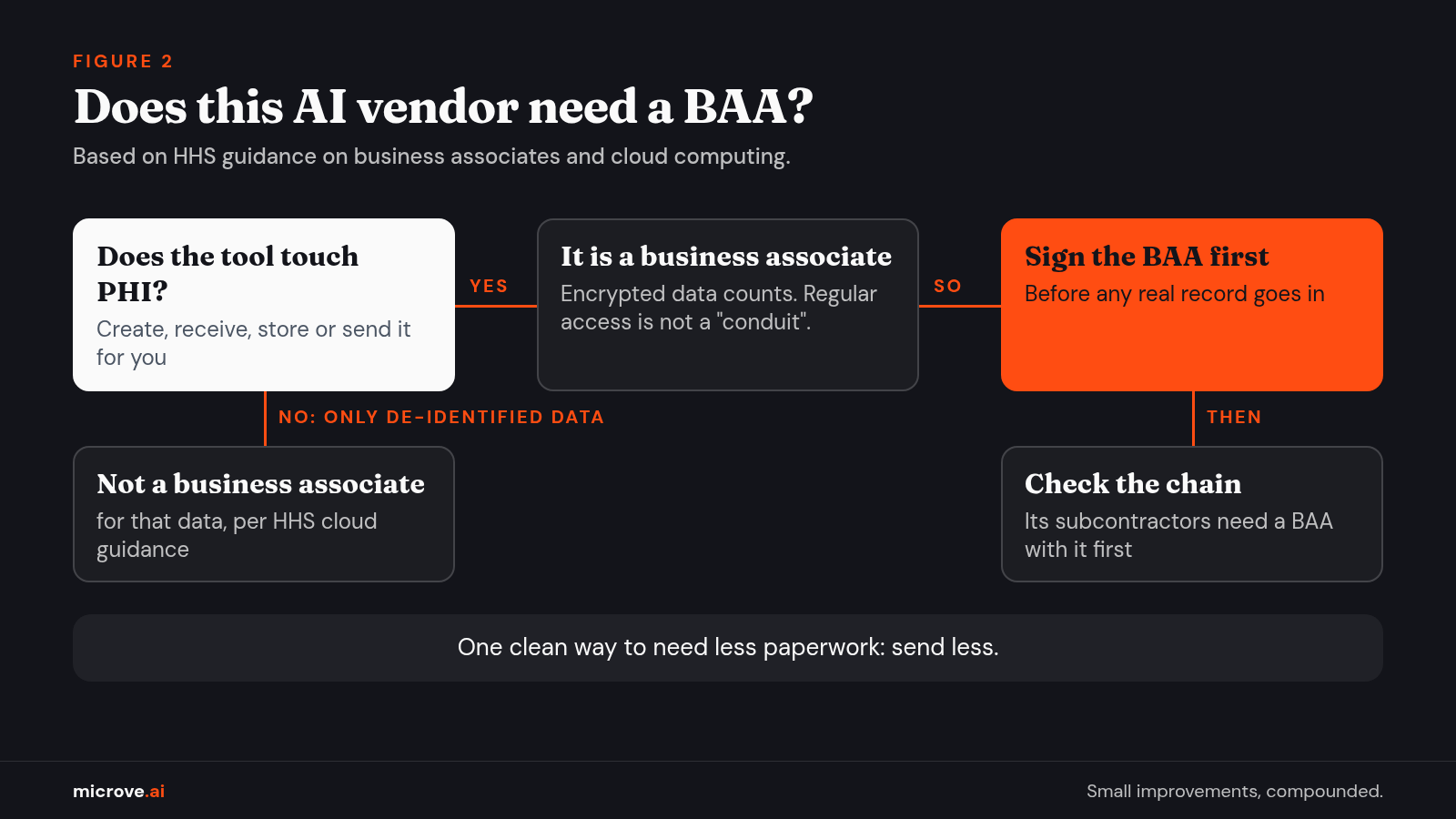
The test is simple to say. If the tool creates, receives, stores or sends PHI for you, the vendor is a business associate. Sign the BAA before the pilot, not after.
HHS makes this concrete. Its business associates guidance (content last reviewed Oct 21, 2026) lists, as an example, a third-party chatbot on a provider's patient portal that handles symptom checks, medical reminders and appointment scheduling with the patient's PHI.
Three details catch people out:
- The chain counts. Your vendor may send text to another company's AI model (the program that understands and writes text) or store it with a cloud provider. Those companies are subcontractors. HHS says a business associate must have a BAA with its subcontractor before it shares PHI with it. Ask your vendor who else touches the data.
- Encryption does not remove the need. Encryption scrambles data so only someone with the key can read it. Per the HHS cloud guidance, a cloud provider that stores encrypted PHI is still a business associate, even without the key.
- "We just pass it along" is a narrow exception. HHS limits the "conduit" exception to delivery-only services, like the postal service. A company that accesses PHI regularly to perform a service is not a conduit. An AI that reads a message to answer it is doing more than delivering it.
There is one clean way to need less paperwork: send less. HHS says a cloud provider that receives only de-identified information is not a business associate. De-identified means the data meets HHS's standard for removing what points to a person, for example names, dates and phone numbers. If a task works on de-identified data, that can be the simpler path.
A BAA is necessary. It is not enough.
A signed BAA is the gate. It is not the whole house.
The BAA sets duties on paper. It does not decide whether data leaves your walls in the first place. That is a design choice. Our article on protecting proprietary data covers it.
The BAA also does not do your own homework:
- Risk analysis. HHS says covered entities and business associates must both assess the risks to all the electronic PHI they handle. In plain words: a written look at where PHI lives, what could go wrong, and what you do about it. Add every new AI tool to it.
- Minimum necessary. The Privacy Rule says to use, share and request only the minimum PHI a task needs. A scheduling assistant needs a name, a time and a phone number. It does not need the chart.
- Access by role. The Privacy Rule expects policies that limit who on your staff can reach which PHI, based on their job. Give each person a unique login, and keep a log of who asked the tool what.
- Contract terms worth reading. How long the vendor keeps data. Whether it returns or destroys PHI when the contract ends. How fast it reports a security incident. Whether your data can be used to improve its product.
The order of steps before the pilot
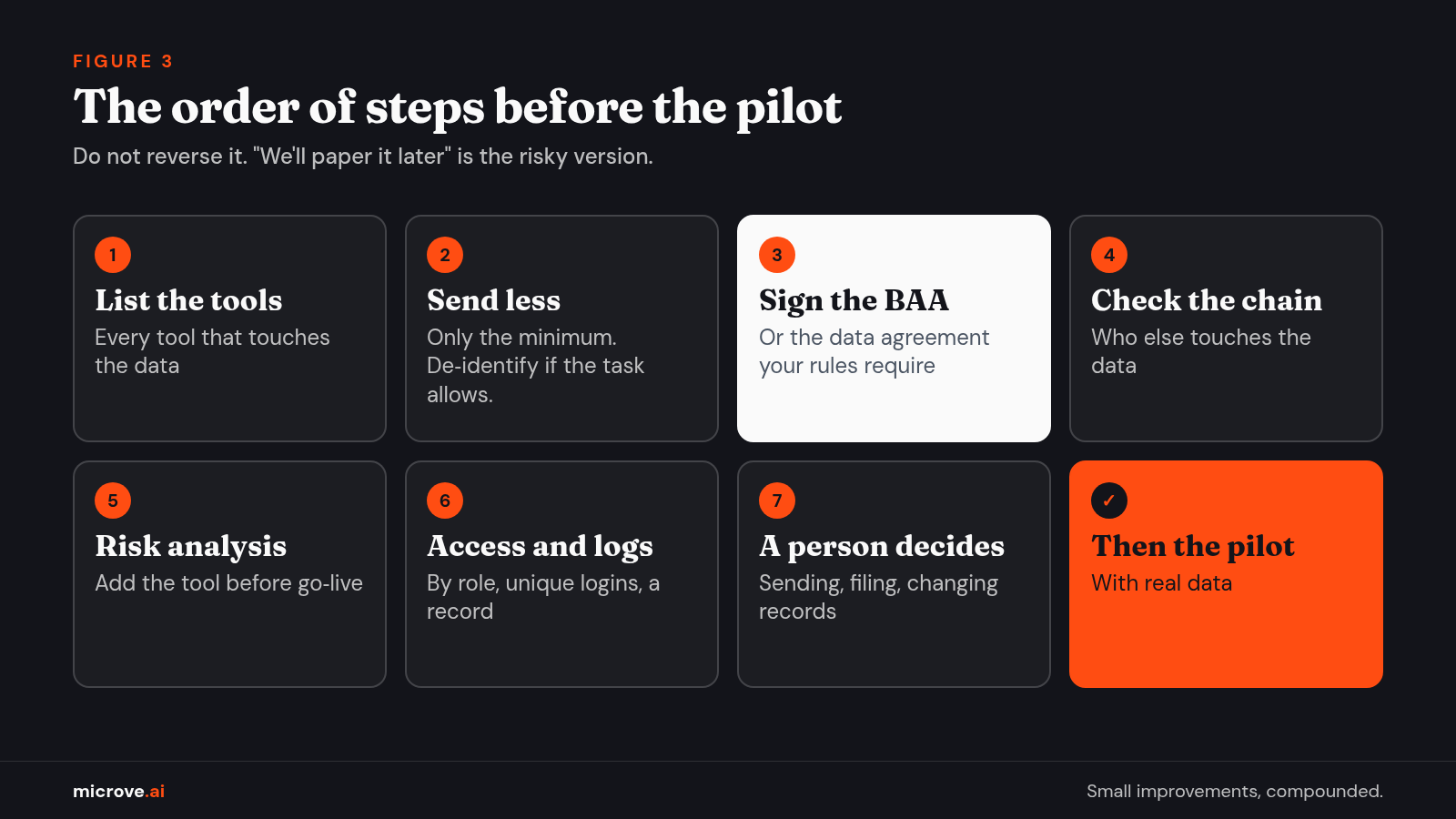
Use this order. Do not reverse it. "We'll paper it later" is how sensitive data ends up with a vendor that has no agreement.
- List every tool that touches the data. Charting, scheduling, scribes, chatbots, billing helpers, and the "just a demo" browser tab.
- Send less. Decide the minimum data each task needs. De-identify when the task allows it.
- Sign the BAA first. Outside healthcare, sign whatever data agreement your own rules and clients require.
- Ask who else touches it. Get the vendor's list of subcontractors that handle the data.
- Add the tool to your risk analysis. Before go-live, not at the next annual review.
- Set access and logs. Access by role, unique logins, and a record of who did what. A private deployment does not set these up for you either.
- Keep a person on the risky steps. Drafts can be automatic. Sending, filing and changing records wait for a person.
The Bottom Line: HIPAA compliant AI needs three things to line up: the right tool, a signed BAA, and your own risk analysis and controls. Sign first. Pilot second. Badge never.
What Microve provides
We implement AI end to end. We find the workflow worth automating, decide the data path, build the tool, connect it to the software you already use, run it, measure the result and, if you want, keep maintaining it.
With health records or other sensitive data, the data path and the paperwork come before the build. Which tools touch the data, which agreements must be signed, and what the tool may see. When the data should not leave your walls, we can use a private deployment, where the model runs inside your environment and prompts are not sent to third-party AI APIs (outside AI services an app sends requests to over the internet).
We will not hand you a HIPAA badge. HHS does not issue one, and a badge was never the point. We will tell you when a tool is not ready for sensitive data. If you don't need AI, we'll tell you that too.
Working with patient records or other sensitive data? Get in touch for a free consultation.