Shadow AI: What It Is and a Free Policy Starter
Staff are already using AI tools you never chose. Here is what that means, how it happens, and a one page policy to fill in.
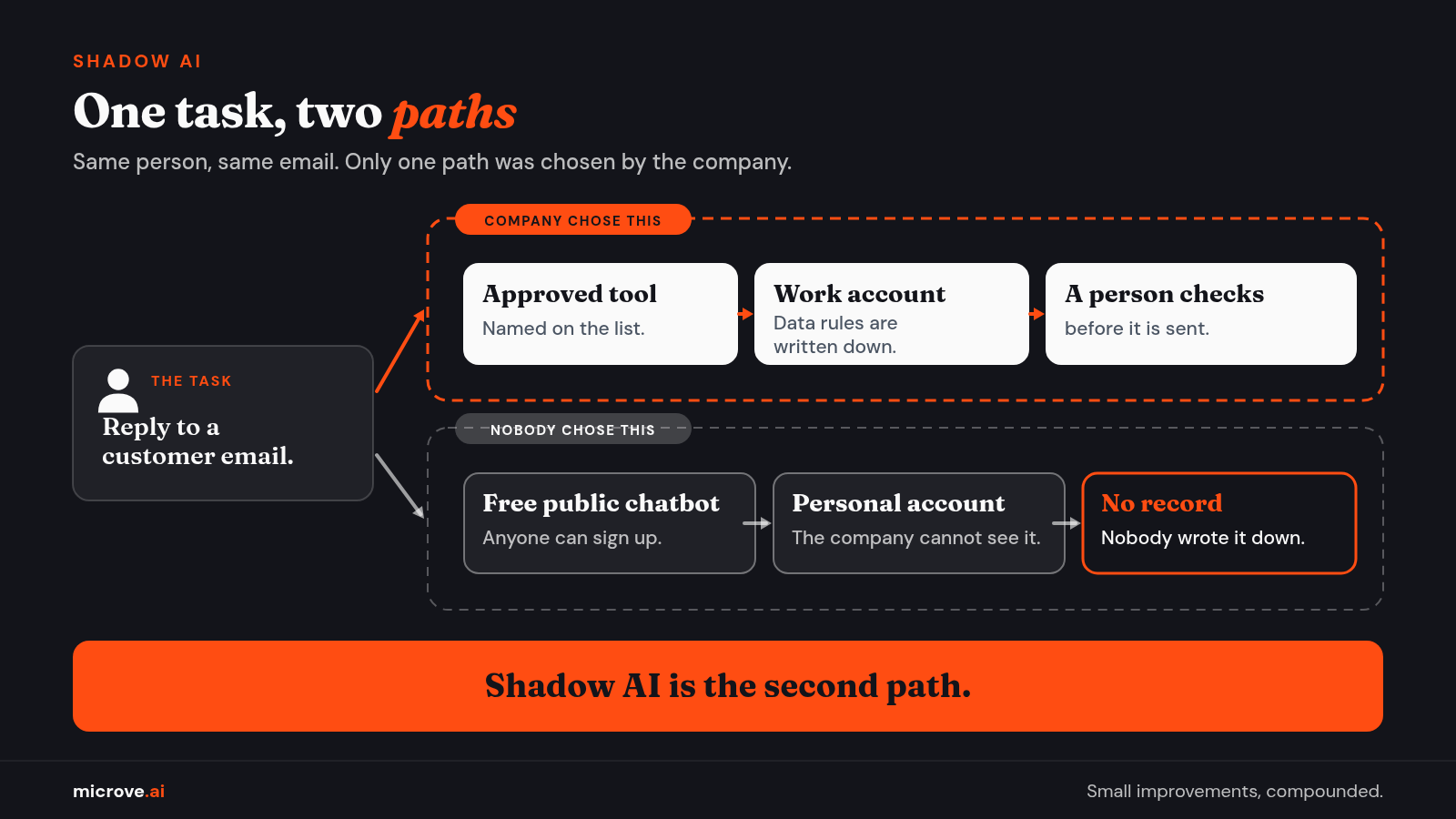
Someone on your team is stuck on a customer email. They open a free chatbot in a browser tab, paste the whole thread, and ask for a polite reply. It works, and it took two minutes. Nobody decided that this customer's email should go to that tool. Nobody wrote down that it did.
That small moment is the whole story of shadow AI. This article explains the term, what surveys do and do not tell us, three everyday habits behind it, and how to write a one page policy. A free starter template is at the end. No sign up.
What shadow AI means
Shadow AI means staff using AI tools for work that the company has not approved. The term is commonly described this way. The National Cybersecurity Alliance, a nonprofit, says in its September 2025 survey report that using AI tools without the knowledge or approval of IT or security teams is "commonly referred to as" shadow AI, a close cousin of shadow IT. Shadow IT is the same idea for any software.
Two quick definitions. An approved tool is one that someone in charge has said yes to, for a named kind of data. In a small team, that person can be the owner or a manager. A public AI tool is a chatbot or app that anyone can sign up for, run by an outside company on its own servers.
Not every use is a problem. Asking a chatbot to reword a public blog post sends nothing sensitive. The risk is in the data. Sensitive data is any information that could hurt a customer, an employee or the business if it reached the wrong person: client files, contracts, prices, source code, employee records.
How common is AI at work, and what do surveys say?
Start with plain use. Gallup's May 2026 survey of more than 22,000 U.S. employees found that 52% use AI in their role at least a few times a year, 30% a few times a week or more, and 15% daily. Gallup measured use, not approved or unapproved use. So AI is normal at work. These numbers do not say how much of it is shadow AI.
Surveys on unapproved use are harder to compare. The ones we found are not limited to the U.S. In a seven country survey by the National Cybersecurity Alliance that included the U.S. (surveyed in May 2025, published September 2025), 43% of people who use AI at work said they had shared sensitive work information with AI tools without their employer's knowledge.
That is 43% of AI users, not of all workers, and it is self reported.
In the same National Cybersecurity Alliance survey, 52% of employed people who use AI across all seven countries said they had not received any training on the security or privacy risks of AI tools.
A 2025 study led by the University of Melbourne across 47 countries found a similar pattern. About half of employees who use AI said they had put company information into a public AI tool. That count includes people who did it rarely.
One more angle uses records instead of answers. A section on AI use in the 2026 Verizon Data Breach Investigations Report draws on data loss prevention records, which are logs of what leaves company devices. It found that 67% of users who reach AI services from company devices do it through non corporate accounts. A non corporate account is a personal login, not a company one.
Our reading: AI use is common, many people say they have shared work data without telling their employer, and training is thin. None of these sources proves what happens at your company. That is why a short list of approved tools beats a guess.
Three everyday habits that send work data places nobody chose
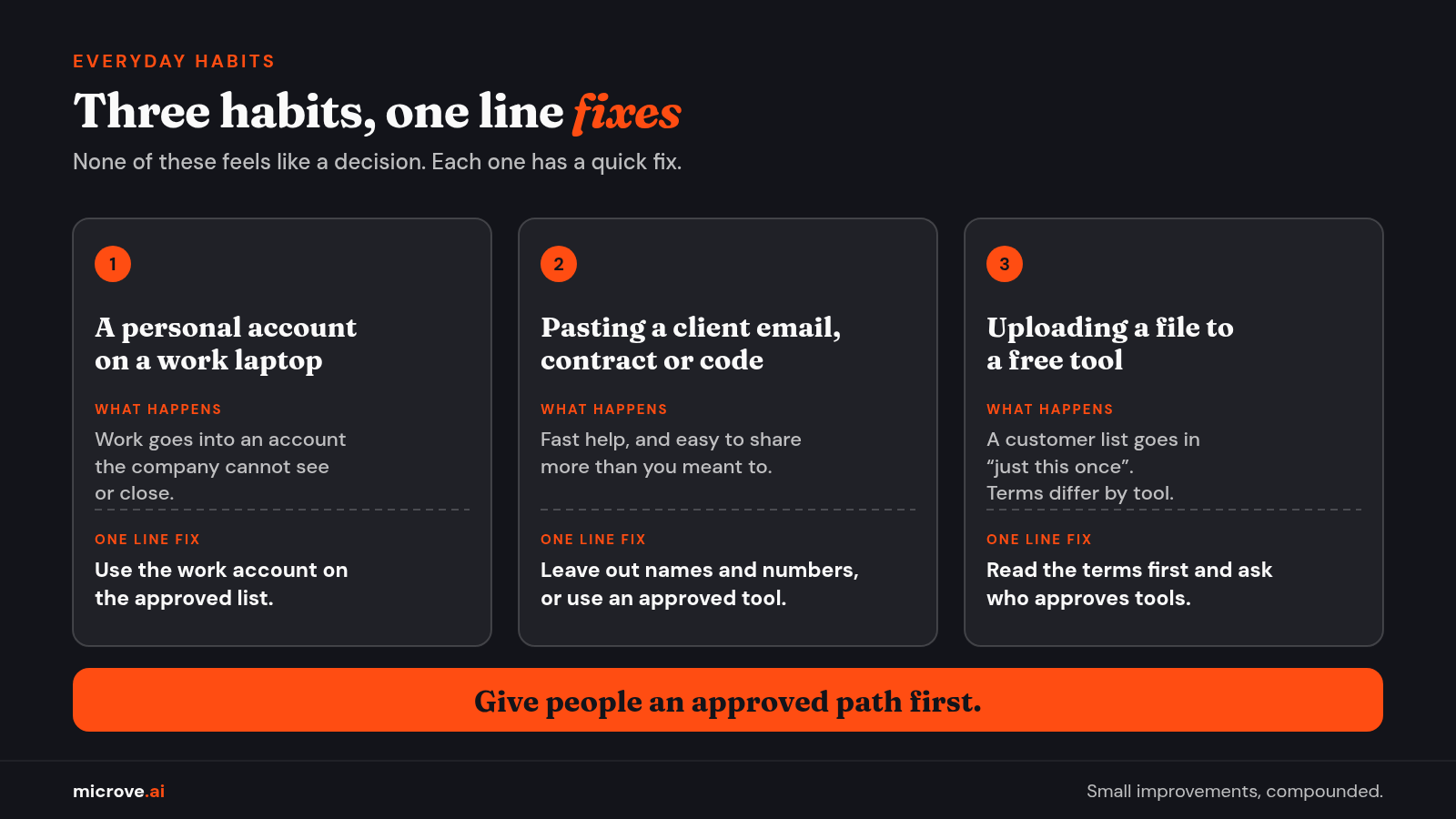
Shadow AI rarely looks like a decision. It looks like a shortcut. Three habits show up again and again, and each has a one line fix.
1. A personal account on a work laptop
Someone signs in to an AI tool with a personal email because it is quicker than asking. The work goes into an account the company cannot see, manage or close when the person leaves. The fix: use the work account named on your approved list, or ask first.
2. Pasting a client email, contract or code
Pasting is the fastest way to get help and the fastest way to share more than you meant to. A contract holds names, prices and terms. Source code shows how your product works. The fix: leave out names and numbers, or use an approved tool set up for that kind of data.
3. Uploading a file to a free tool
A customer list goes into a free converter or summarizer "just this once." Terms differ from tool to tool, and few people read them first. The fix: read the terms before the upload, and ask who approves tools.
This is not only a small team problem. In May 2023, a large electronics maker restricted staff use of generative AI tools on company devices. Generative AI means AI that creates text, images or code from a prompt.
News reports, citing a company memo, said some staff had uploaded internal source code to a public chatbot. We call this work data entered into a public AI tool. It is not a clean example of shadow AI, because the company had allowed some use first.
Why a ban on its own is a weak plan
It is tempting to write "no AI at work." In our view, that fails for a simple reason: the task is still there. If the approved route is slower than the free chatbot, people take the chatbot.
A better first step is a short list of approved tools for named kinds of data, plus one person who can say yes quickly. If you are choosing a tool, our twelve questions to ask before you sign help you compare providers in writing.
A one page AI acceptable use policy
An acceptable use policy is a short written rule on what people may and may not do with a tool. For AI, one page is enough to start. Two public documents show what such a policy can cover.
NIST's generative AI profile (July 2024) is voluntary guidance from the U.S. standards agency. It suggests that organizations keep an inventory of the AI systems they use, keep a list of approved AI providers, and write acceptable use policies that cover the tools and the people who use them, including contractors. It is written for any organization that builds or uses generative AI, so treat it as a reference, not a checklist.
A 2026 AI acceptable use policy from a Texas state agency is one example, written for the people who use that agency's systems, including employees and contractors. It limits those users to approved AI tools, allows public AI tools only with written supervisor approval, and bans entering confidential, sensitive or personal information into them. It is one agency's rule, not a state law and not a standard for businesses.
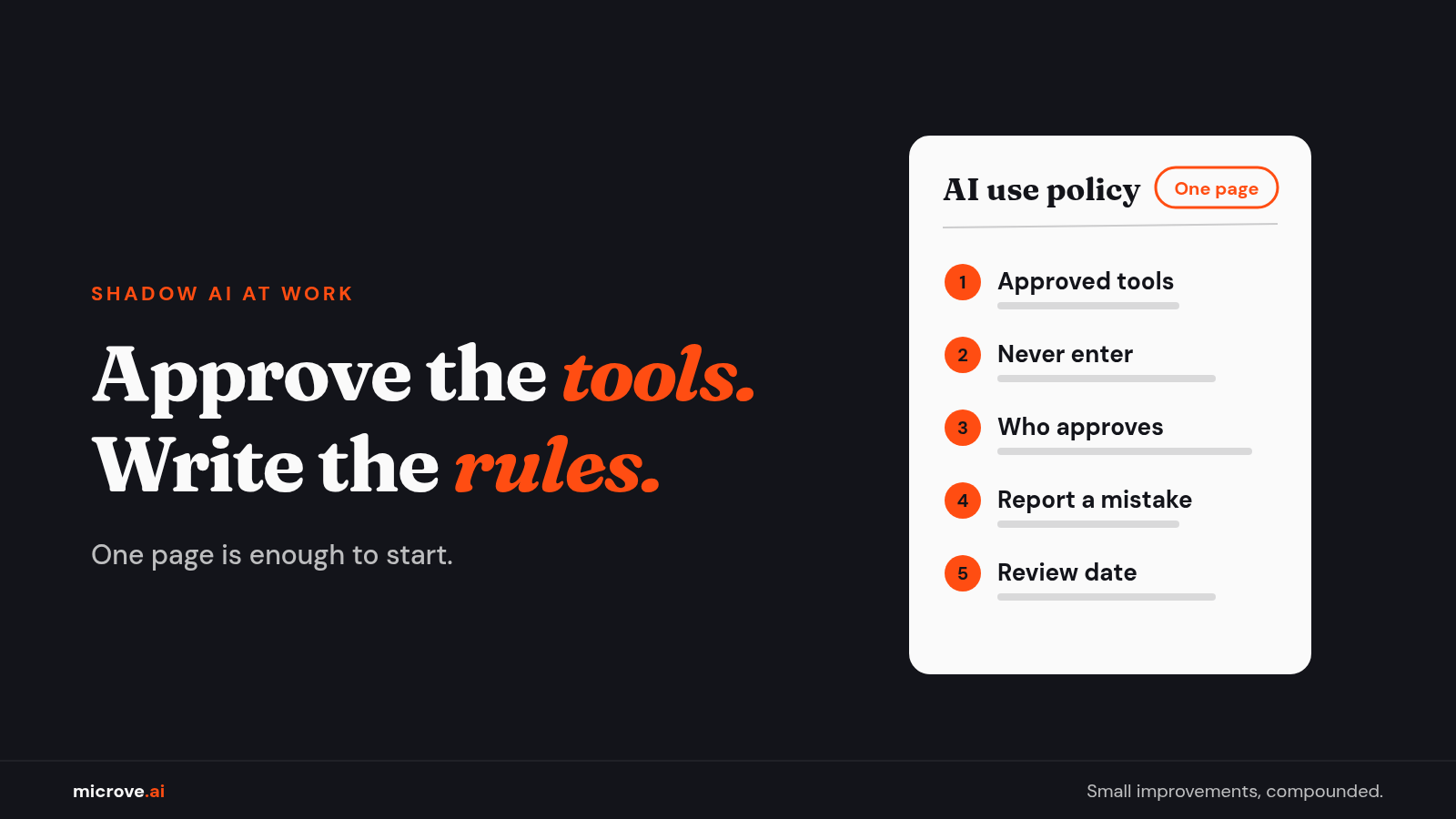
Our starter has five parts.
- Approved tools. Each tool, what it is for, and who said yes.
- Never enter. The data that never goes into an outside AI tool, such as customer personal data, passwords and contracts.
- Who approves. One named person or role who approves new tools, in writing.
- Report a mistake. Who to tell, and how fast, if something was entered by mistake.
- Review date. A date to check the list again.
The page also has one extra line: a person reads and checks anything AI writes before it goes to a customer or is used for a decision.
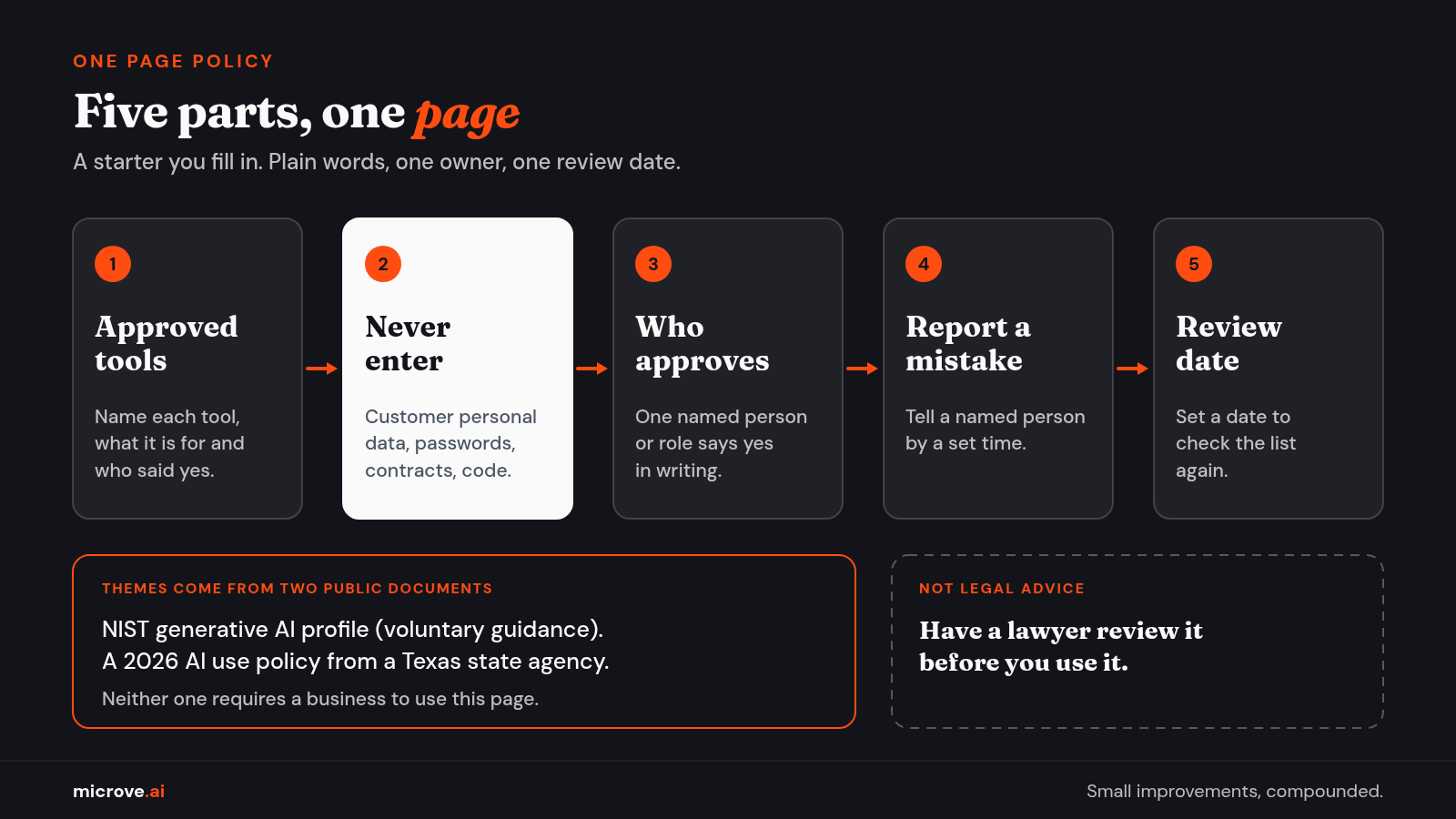
This starter is not legal advice. Have a lawyer review it before you use it, because rules differ by industry and contract. State privacy laws also differ, so ask a lawyer which ones apply to the customer data your team handles.
Download the starter: PDF or Word. It is free, with no sign up and no email address needed. For why a promise in a contract is not the same as keeping data in your control, see how to protect proprietary data when you use AI.
What Microve provides
We build working tools end to end. For shadow AI, that starts with a conversation about how your team uses AI today and which tasks push people toward free tools.
Then we help you pick approved tools and build private workflows that do the task inside your own software, so staff do not need an unapproved one. We connect each one to the tools you already use, then run it and keep it working.
With a private deployment, the model runs inside your environment, and prompts are not sent to third party AI APIs. The model is the AI system that reads a prompt and writes the answer. An API is a connection that lets one program send requests to another company's service. That applies to private deployments only. A private setup is not automatically secure. Access control, settings and monitoring still matter.
When we build a custom tool, the client owns it. Ongoing maintenance is an optional monthly plan. And if an approved tool you already use covers the job, we'll tell you.
The Bottom Line: Shadow AI is a path nobody chose. Name the approved tools, say what never goes in, name who approves, say how to report a mistake, and set a review date.
Want help choosing approved tools? Start with a free consultation.
SOURCES
Surveys and reports
- National Cybersecurity Alliance and CybSafe, "Oh, Behave! The Annual Cybersecurity Attitudes and Behaviors Report 2025 to 2026," September 2025 (survey fielded May 2025). https://20740408.fs1.hubspotusercontent-na1.net/hubfs/20740408/CYBSAFE-Oh%2c%20Behave!%20The%20Annual%20Cybersecurity%20Attitudes%20and%20Behaviors%20Report%202025-2026-250929%20VB.pdf
- National Cybersecurity Alliance, press release, September 30, 2025. https://www.staysafeonline.org/press/study-65-now-use-ai-but-majority-remain-untrained-on-risks
- Gallup, "Organizational adoption jumps six points," July 20, 2026. https://www.gallup.com/workplace/712736/organizational-adoption-jumps-six-points.aspx
- Gallup, artificial intelligence indicator page (figures as of May 2026). https://www.gallup.com/699797/indicator-artificial-intelligence.aspx
- University of Melbourne and KPMG, "Trust, attitudes and use of AI: A global study 2025," 2025. https://assets.kpmg.com/content/dam/kpmgsites/xx/pdf/2025/05/trust-attitudes-and-use-of-ai-global-report.pdf
- Verizon, 2026 Data Breach Investigations Report, May 2026, report PDF, "Key topics and findings," page 13. https://www.verizon.com/business/resources/Tdca/reports/2026-dbir-data-breach-investigations-report.pdf
News reports on the May 2023 incident
- TechCrunch, May 2, 2023, on the temporary restriction and the March 11, 2023 allowance for one division. https://techcrunch.com/2023/05/02/samsung-bans-use-of-generative-ai-tools-like-chatgpt-after-april-internal-data-leak/
- The Verge, May 2, 2023, on the source code detail, citing Bloomberg. https://www.theverge.com/2023/5/2/23707796/samsung-ban-chatgpt-generative-ai-bing-bard-employees-security-concerns
- The Economist Korea, March 30, 2023 (in Korean), on the earlier allowance. https://economist.co.kr/article/view/ecn202303300057
- iNews24, March 10, 2023 (in Korean), on the earlier allowance. https://www.inews24.com/view/1574326
Policy documents
- National Institute of Standards and Technology, AI 600-1, Generative AI Profile, July 26, 2024. https://www.nist.gov/publications/artificial-intelligence-risk-management-framework-generative-artificial-intelligence and https://nvlpubs.nist.gov/nistpubs/ai/NIST.AI.600-1.pdf
- Texas Department of Information Resources, AI Acceptable Use Policy, version 1.0, March 13, 2026. https://dir.texas.gov/sites/default/files/2026-04/AI%20Acceptable%20Use%20Policy.pdf