A Workout Buddy, Not a Doctor: ChatGPT for Health and Fitness
Use ChatGPT to plan a gentle workout, prepare questions for your doctor and learn what lab report words mean. Your doctor still decides.
Part 3 of 6 in ChatGPT for Daily Life. All six parts of ChatGPT for Daily Life.
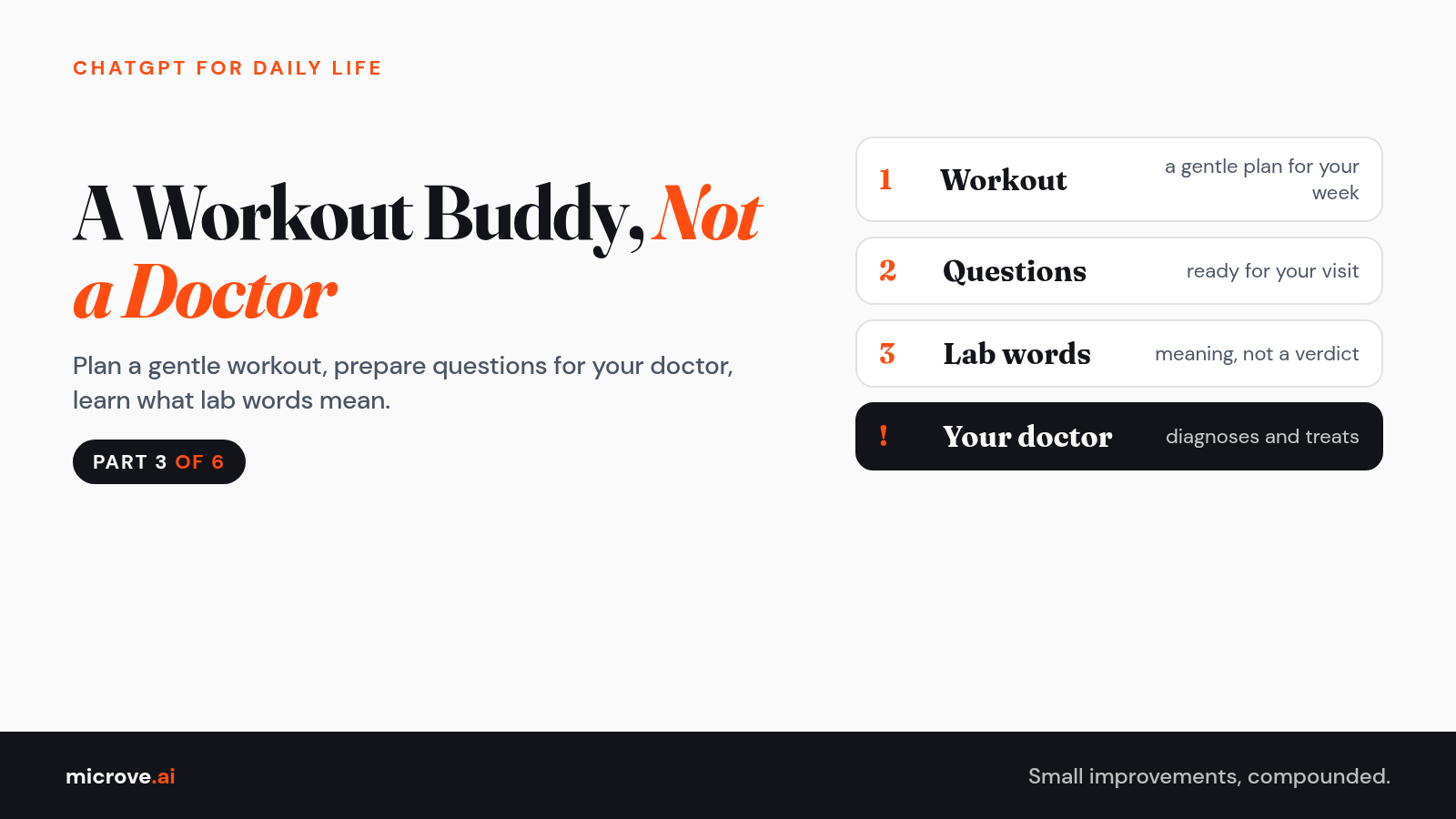
Meet Sam. He is made up, but you know him. He is 45, sits most of the day, and owns running shoes that mostly run errands.
Sam also has a doctor visit next week about his knee, and a lab report full of capital letters.
This is not about work. It is about your body, your week and your next appointment.
In Part 1 you learned the loop: ask, read, follow up. Today Sam uses it for his health, with one firm rule.
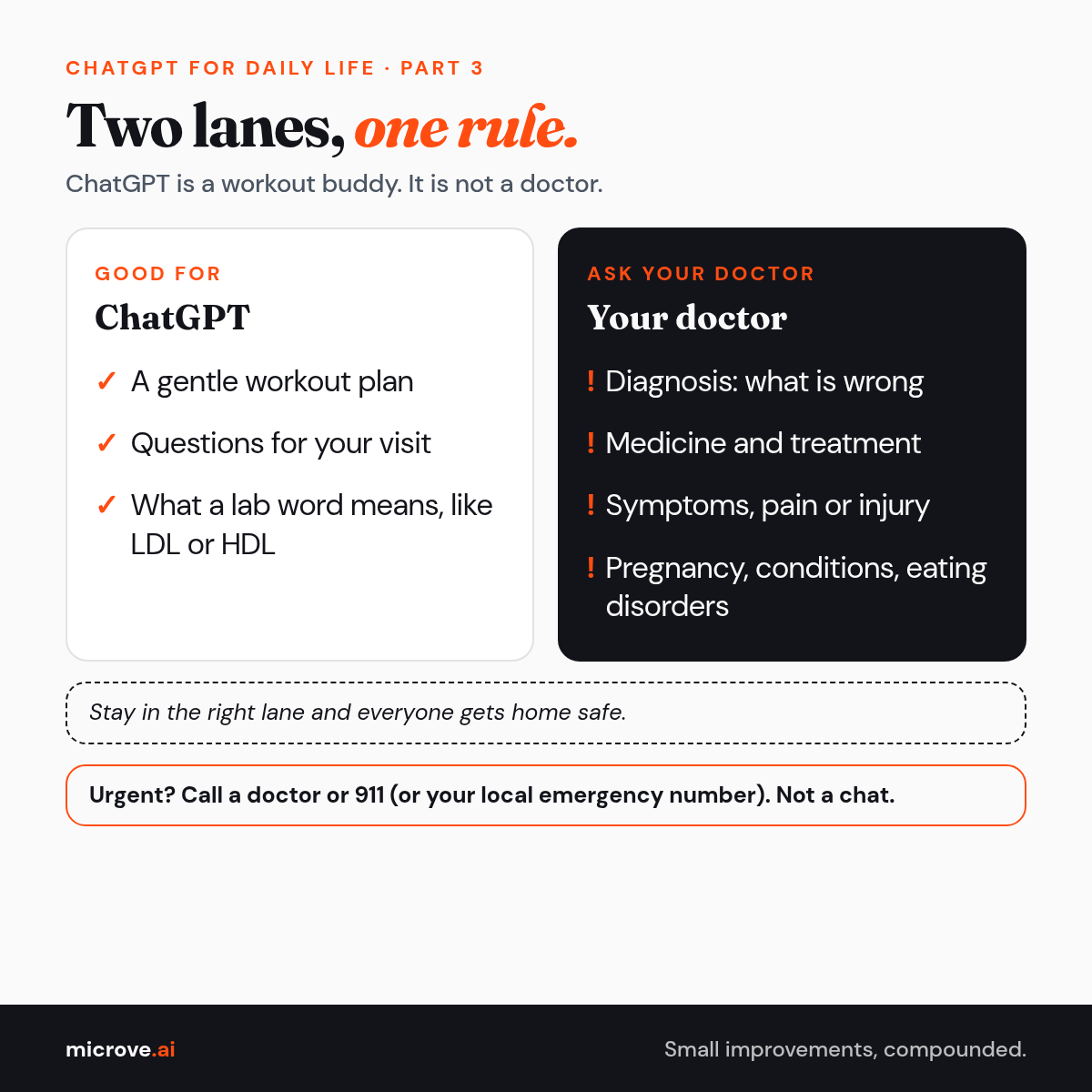
The one rule: two lanes
ChatGPT can be a good workout buddy. It is not a doctor. It cannot examine you, and it can be wrong while sounding sure.
OpenAI says so too. Its Terms of Use say not to rely on ChatGPT's answers "as a substitute for professional advice."
A diagnosis is a doctor's answer to "what is wrong with me?" That answer needs an exam, your history and often tests. A chat has none of those.
So picture two lanes on a road:
- ChatGPT's lane: plans, questions and words. A workout draft, questions for an appointment, the meaning of a term.
- Your doctor's lane: diagnosis, medicine and symptoms. Pain, injury, pregnancy, medical conditions, medicines and eating disorders all live here.
Stay in the right lane and everyone gets home safe.
A gentle workout plan
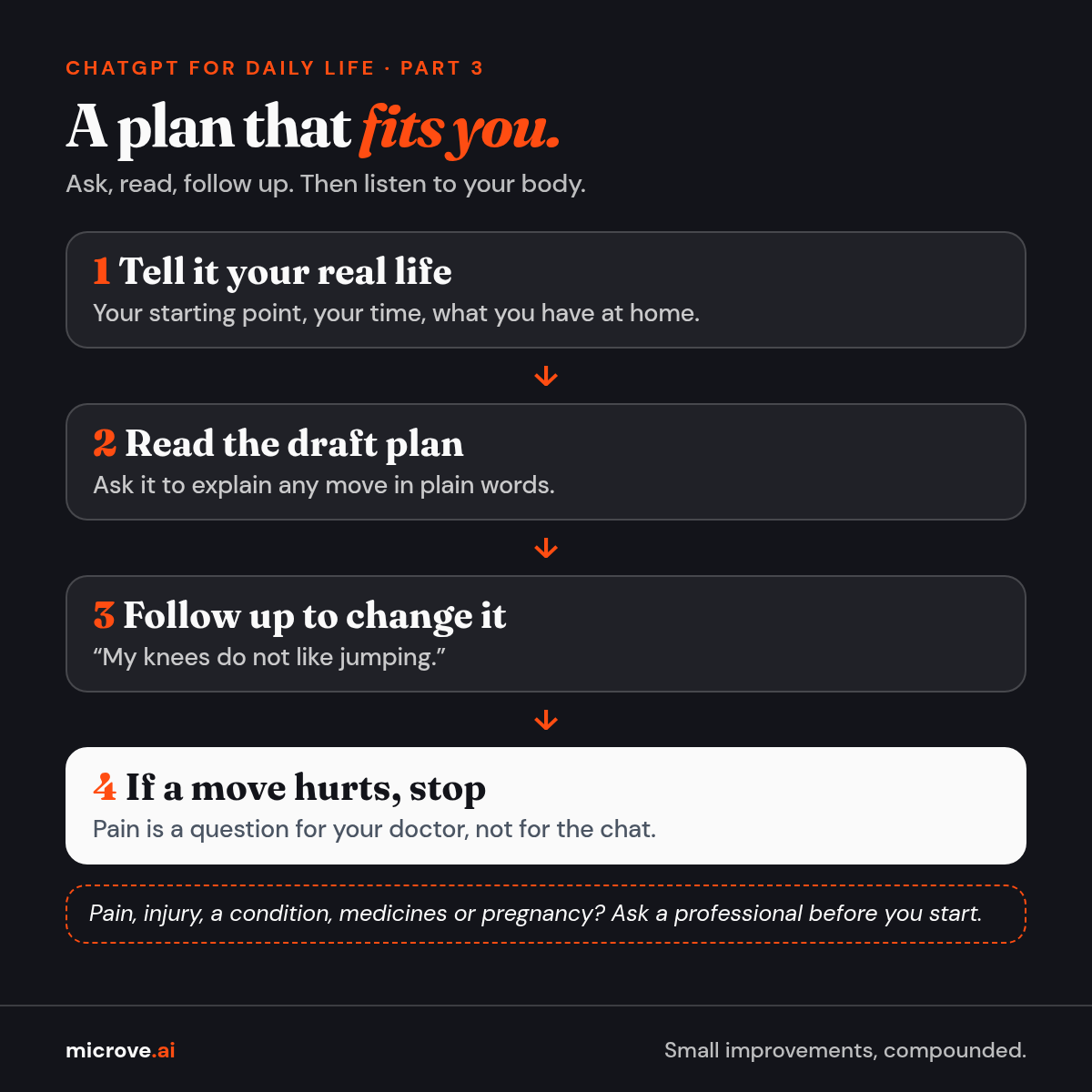
Tell ChatGPT three things: where you are starting, how much time you have and what you have at home.
- Open the ChatGPT app on your phone, or go to chatgpt.com on your computer.
- Copy the prompt below. Change the details to yours.
- Read the plan. If a move sounds strange, ask: "Explain this move in plain words."
- Follow up to change it. The first answer is a draft.
Copy this prompt:
I am 45, I sit most of the day, and I have 20 minutes three times a week. Make me a gentle beginner workout plan with no equipment. Explain each move in plain words. Ask me two questions before you start.
Sam read the plan and saw jumping jacks. His knees filed a complaint. So he followed up:
Make this workout plan easier. My knees do not like jumping. Swap any jumping moves for something calmer.
The CDC says some physical activity is better than none. It also says to talk with your doctor first if you have a chronic condition, such as heart disease, arthritis or diabetes.
Our rule is wider. If you have pain, an injury, a medical condition, take medicines, are pregnant or have a history of an eating disorder, ask a professional before you start. Sam's knee is on that list, so he will ask about the plan at next week's visit. If a move hurts, stop. Pain is a question for your doctor, not for the chat.
Questions for your doctor
Doctor visits are short. Most of us remember our best question in the parking lot.
ChatGPT can help you arrive ready. Its job is not to guess what is wrong. It helps you say what you noticed, clearly.
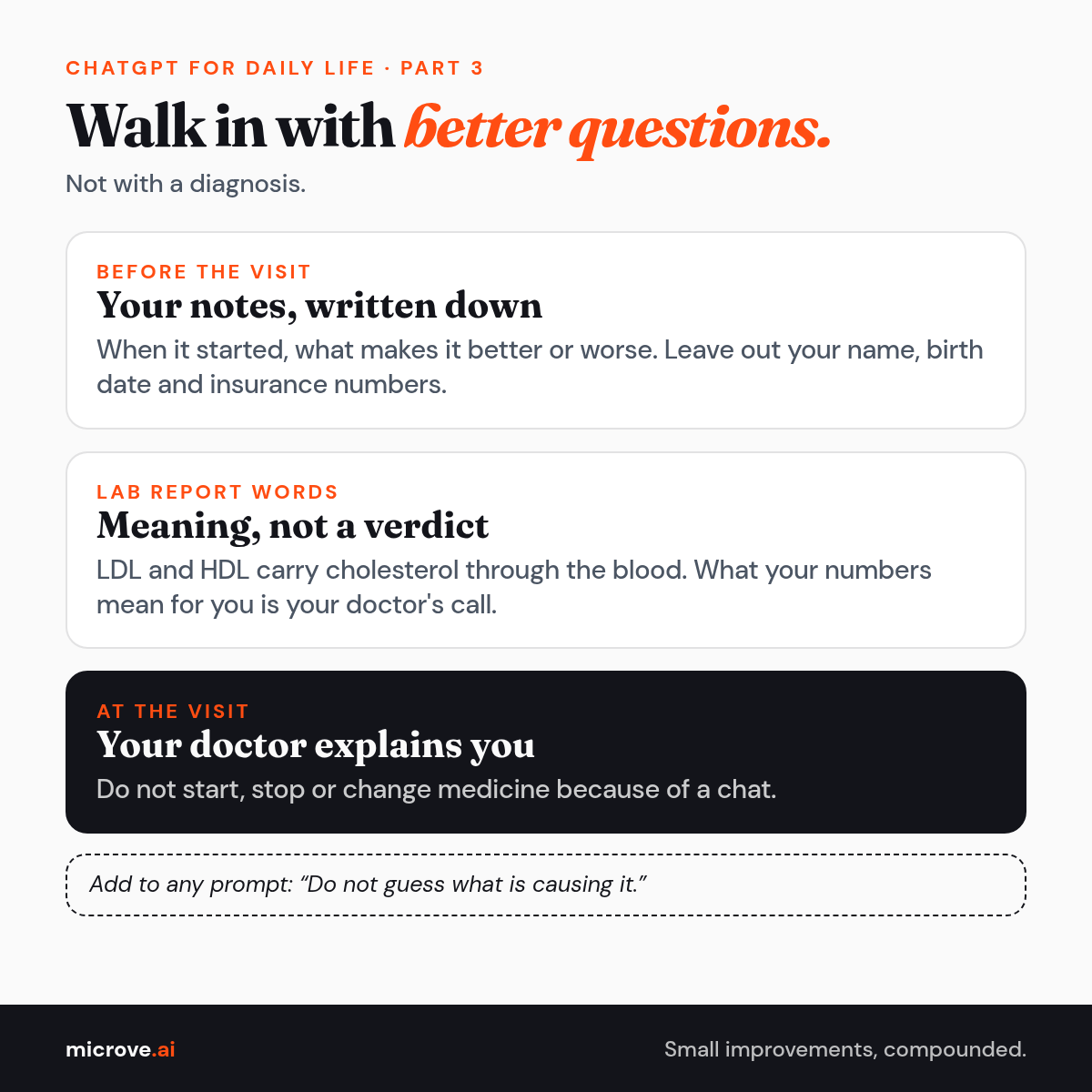
- Write a few notes: when it started, what makes it better or worse.
- Paste them with the prompt below. Leave out your name, birth date and insurance numbers.
- Save the list on your phone and bring it.
Copy this prompt:
I have a doctor visit next week about my knee pain. Help me write a list of questions to ask, and what details the doctor may want to know. Do not guess what is causing it. Keep it to one page.
If it guesses at causes anyway, type: "Please do not guess. Just help me with questions." If it still guesses, skip that part.
Words on a lab report
A lab report is the page of results after a test, like a blood test. LDL and HDL are two common ones.
ChatGPT can explain what a word means. What your numbers mean for you needs your history, your other results and your doctor.
Copy this prompt:
My lab report says "LDL" and "HDL". What do these words mean in plain language? Do not tell me what my numbers mean for me. I will ask my doctor.
Then check it against a trusted source. MedlinePlus, from the US National Library of Medicine, explains it this way.
Cholesterol is a waxy, fatlike substance your body needs. LDL and HDL are lipoproteins: fat and protein that carry cholesterol through the blood.
LDL is sometimes called the "bad" cholesterol, because a high level leads to buildup in your arteries. HDL is sometimes called the "good" cholesterol, because it carries cholesterol back to your liver, which removes it.
That is where the words end and your doctor begins.
A short safety tip
ChatGPT can explain words. Your doctor explains you. Do not start, stop or change any medicine or treatment because of a chat. Before you paste anything from a report, remove your name, birth date and patient numbers. If something feels urgent, call a doctor or 911 (or your local emergency number). Do not wait for a chat to answer.
Try this today
- Think of your next appointment, or the one you keep putting off. (We see you.)
- Open ChatGPT and copy this prompt:
Help me write three questions for my next doctor visit about [topic]. Do not guess any causes. Keep each question short.
- Put them in your own words.
- Save them in your phone's notes app. Done in under 10 minutes.
Let ChatGPT plan, prepare and explain. Let your doctor diagnose and treat. Next Saturday, Part 4: trips and weekends without the group chat chaos. All six parts of ChatGPT for Daily Life.