What a Forward Deployed Engineer (FDE) Does
A forward deployed engineer, or FDE, stays to build a working tool. Here is what the title means and how it differs from nearby roles.
You may have seen a new title on a job post or on a sales call: forward deployed engineer, or FDE.
If you buy AI work for a company, the title is worth a closer look. An FDE is not the same thing as a consultant, and it is not the same thing as a sales engineer. The difference is what happens after the meeting.
One person can leave you with a plan. Another can help you choose a product. An FDE is hired to stay and build a tool your team can use in daily work.
This article explains the title in plain words, shows how it differs from nearby roles, and lists what to ask before you hire.
What a forward deployed engineer is
A workflow is the chain of steps a task goes through. Think of an order email that is read, checked against the order, answered and then logged in a spreadsheet. That whole chain is a workflow. A forward deployed engineer is a software engineer who sits with the people who do that work, then builds a tool that can run the steps.
The point of the title, as companies use it, is production. Production means real, daily use, not a polished demo and not a short trial. A short trial with a few users is a pilot. A pilot is useful, but it is not the finish line. An FDE is usually judged on whether the tool is still doing the job after the pilot ends.
Palantir, OpenAI and Anthropic are examples of companies that use the FDE title.
Palantir's chief technology officer, Shyam Sankar, wrote in April 2024 that he gave the work the name forward deployed engineering in 2007. (Source: Shyam Sankar, "The Primacy of Winning," Pirate Wires, 8 Apr 2024.) Our view: that is his account of the name. Palantir still uses the title.
OpenAI published an official note, "What FDE means at OpenAI," on 22 Oct 2026. It says the company's FDE team was founded in early 2025 to close what it calls a deployment gap: the distance between what a model appears able to do and what people can reliably use at work.
A model is the trained program that reads text or images and writes an answer. The note says FDEs work alongside customers and aim to solve the problem to a standard they can stand behind in production. (Source: What FDE means at OpenAI, 22 Oct 2026.)
Anthropic lists a Forward Deployed Engineer role that works with customer teams to build production applications, meaning tools meant for daily use, not only a slide or a demo. (Source: Anthropic Forward Deployed Engineer listing, accessed 11 Nov 2026.)
Building a model is not the same as getting it into a workflow. You can have a clever model that still leaves someone copying answers into a spreadsheet. The FDE title sits on that second job: get the work into daily use.
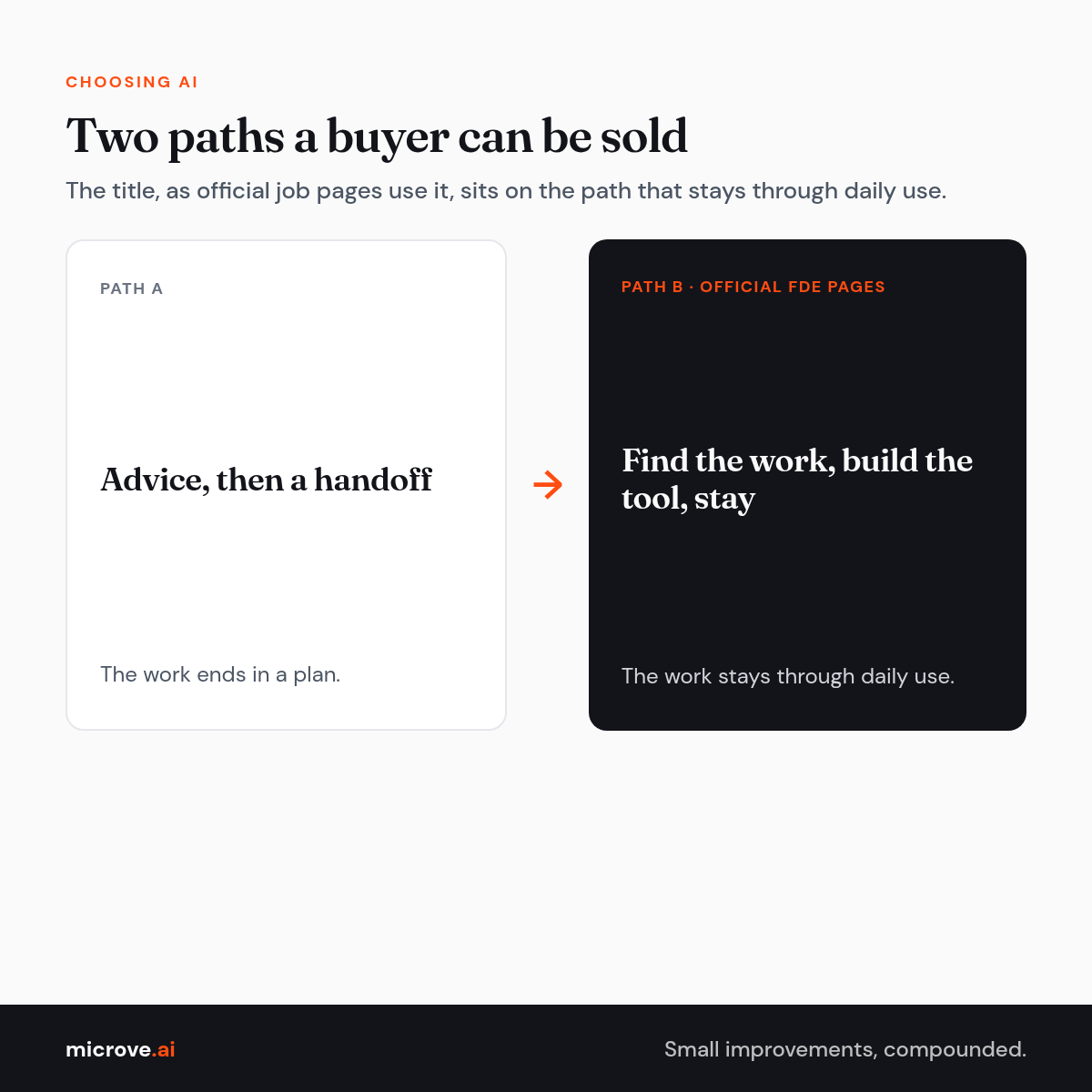
Our view: if a pitch uses the FDE title but the work ends at a slide deck, you are not looking at the job those official pages describe. You are looking at a new label on an old meeting.
How an FDE differs from a consultant, a solutions engineer and a sales engineer
People mix these titles because all of them talk to customers. They can sound the same until you ask what will exist on Friday, and who will keep it working.
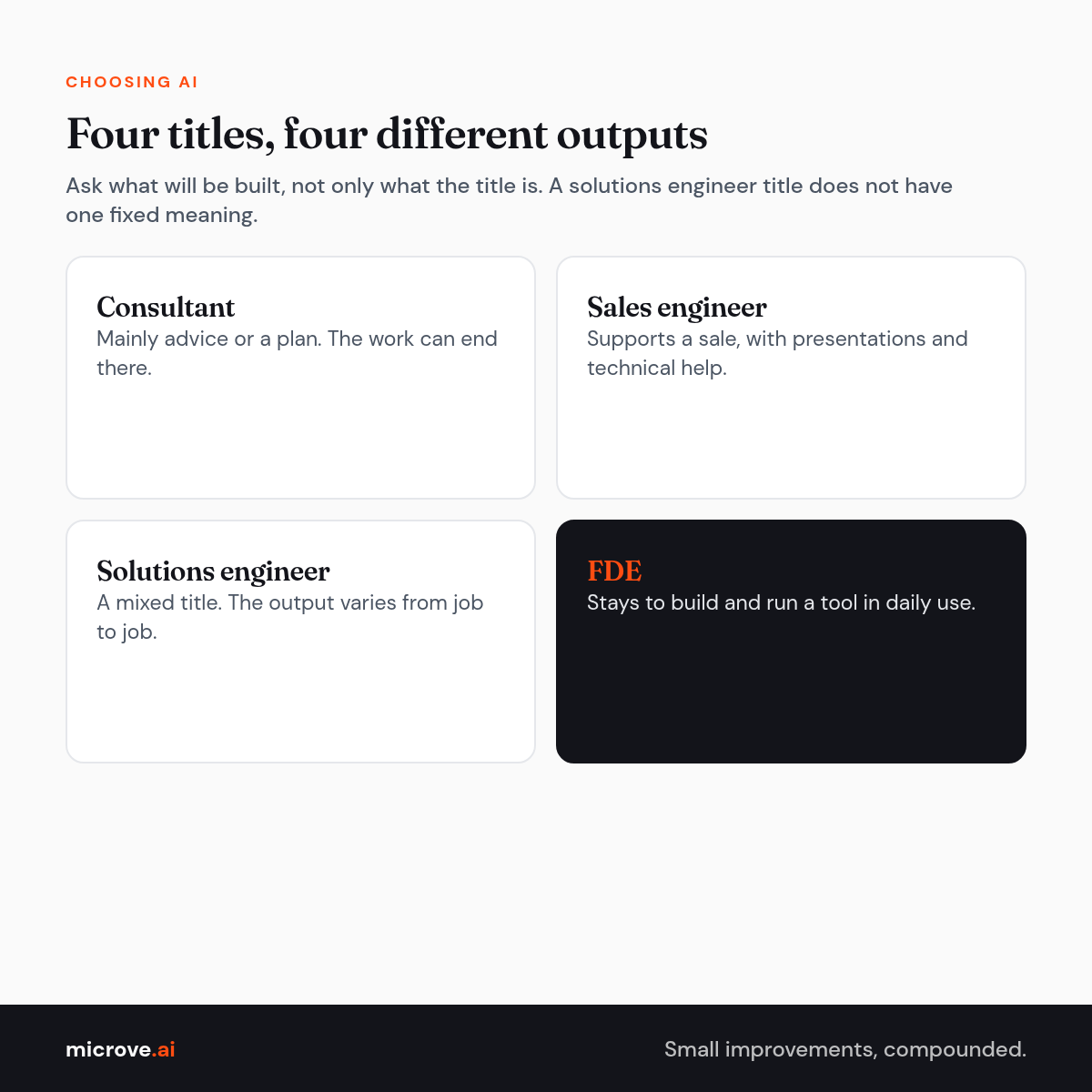
A consultant is someone you hire mainly to advise or to write a plan. A good consultant can help you see where AI fits and where it does not. When the work stops at a recommendation, your team still has to build the tool, connect it to the software you already use and keep it running.
For a plain walk through of implementation work, from the first meeting to daily use, see What an AI Implementation Consultant Actually Does.
A sales engineer is a technical person who works with a sales team. The U.S. Bureau of Labor Statistics, in its Occupational Outlook Handbook (last modified 27 Aug 2026), says sales engineers "sell business products or services, such as software or support, that require technical expertise." Their duties include presentations, work with the sales team, and help with installation and support. The work is tied to a sale. (Source: Sales Engineers, Occupational Outlook Handbook.)
A solutions engineer is a mixed title. At some firms the person designs how a product would fit, or builds a short trial. At other firms the duties overlap with a sales engineer or with an FDE. Our view: do not assume the title tells you what you will get. Ask what they will build, who will run it and who owns the result.
An FDE, as official job pages use the title, is an engineer who stays to build and run the tool. OpenAI's FDE job page in San Francisco, live as of 11 Nov 2026, says the role covers discovery, technical scoping, system design, build and production rollout, and that the person works closely with the customer's team. (Source: OpenAI Forward Deployed Engineer job page, accessed 11 Nov 2026.)
If someone uses the FDE title in a pitch, ask a simple question. Will you still be here when the tool is in daily use, and who owns it then? The title does not, by itself, tell you whether the person works in your office or meets by video. Ask how they sit with the people who do the task.
What a buyer should check, including privacy
You do not need a certain title to buy good work. You need a clear picture of the job.
Ask what will be built, not only what will be advised. Ask how they sit with the people who do the task today. Ask who owns the tool at the end. When we build a custom tool, the client owns it. Ongoing maintenance is an optional monthly plan. If a provider adapts one of its own products, you may get a license instead. Both exist, so know which one you are buying.
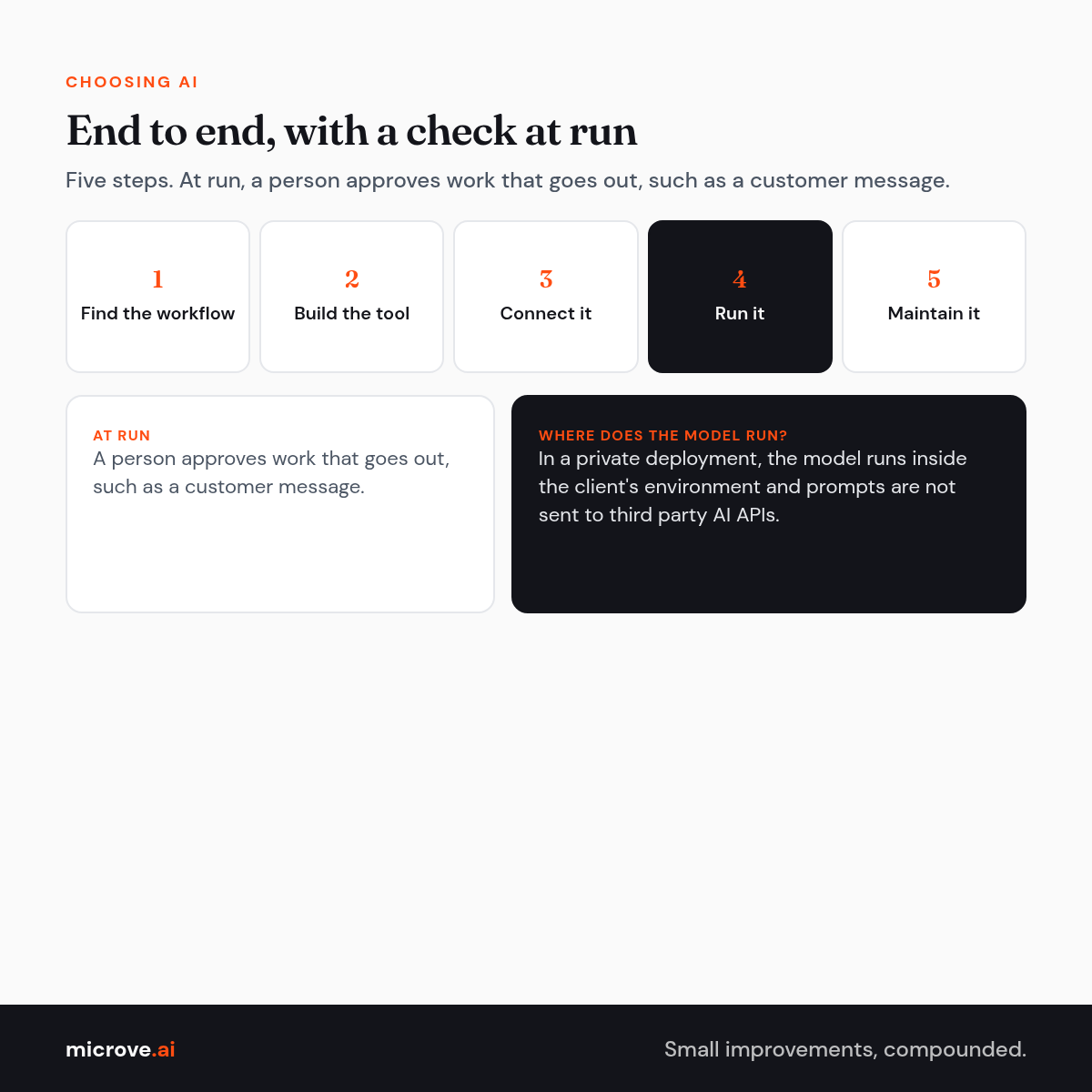
Ask where the model runs. Custom AI can run on private hardware the client controls. In a private deployment, the model runs inside the client's environment and prompts are not sent to third party AI APIs. A prompt is the instruction sent to the model, such as "read this order email and draft a reply."
That privacy claim applies to a private deployment. It is not true of every AI tool, and it is not automatic just because someone uses the FDE title. For a list of questions to ask any provider, see Before you sign: where will our AI run?.
Ask who maintains the tool after launch, and how you leave if you want to. Ask where a person approves work that goes out of the company, such as a message to a customer or a change in a record. A person in the loop means a person reviews or signs before that step is finished.
The same questions apply whether the person across the table is called an FDE, a consultant or something else. The title is a clue. The written scope is the proof.
How Microve does this work
We build custom AI tools for small, medium and enterprise businesses. We sit with the people who do the task and pick one workflow that repeats and eats hours. Then we do the work end to end: we find the workflow, build the tool, connect it to the software the client already uses, run it and maintain it.
Microve has forward deployed engineers, depending on the size of the client. We also have consultants and sales engineers. There are several ways we can serve different kinds of customers. The aim does not change with the role. You should still get a working tool, not only a plan.
For the full picture of that implementation work, see AI Implementation Services: One Workflow, End to End.
If you don't need AI, we'll tell you. If you do, start with one workflow.