AI IMPLEMENTATION
AI Implementation Services: One Workflow, End to End
We do the whole job: find the workflow, build the AI tool, connect it to your software, run it and keep it working.
AI consulting services that end in a working tool
AI consulting services should end in something your team uses. A slide deck has never answered a customer email.
People look for an AI consultant when one task takes too long or goes wrong too often. We call that task a workflow: the chain of steps work goes through. For example, an order email gets read, checked against the order, answered and logged in a spreadsheet.
That is our AI implementation work: we pick one workflow like that, build a tool for it, connect it to your systems, run it and keep it running.
We are not a strategy firm. We build working tools.
Want the full picture of the role first? Read what an AI implementation consultant actually does.
Problem first.
We start with the work your team does, not with the technology.
Built to fit.
The tool lives in the software your team already uses.
Measured.
One success metric, agreed before the build and checked after launch.
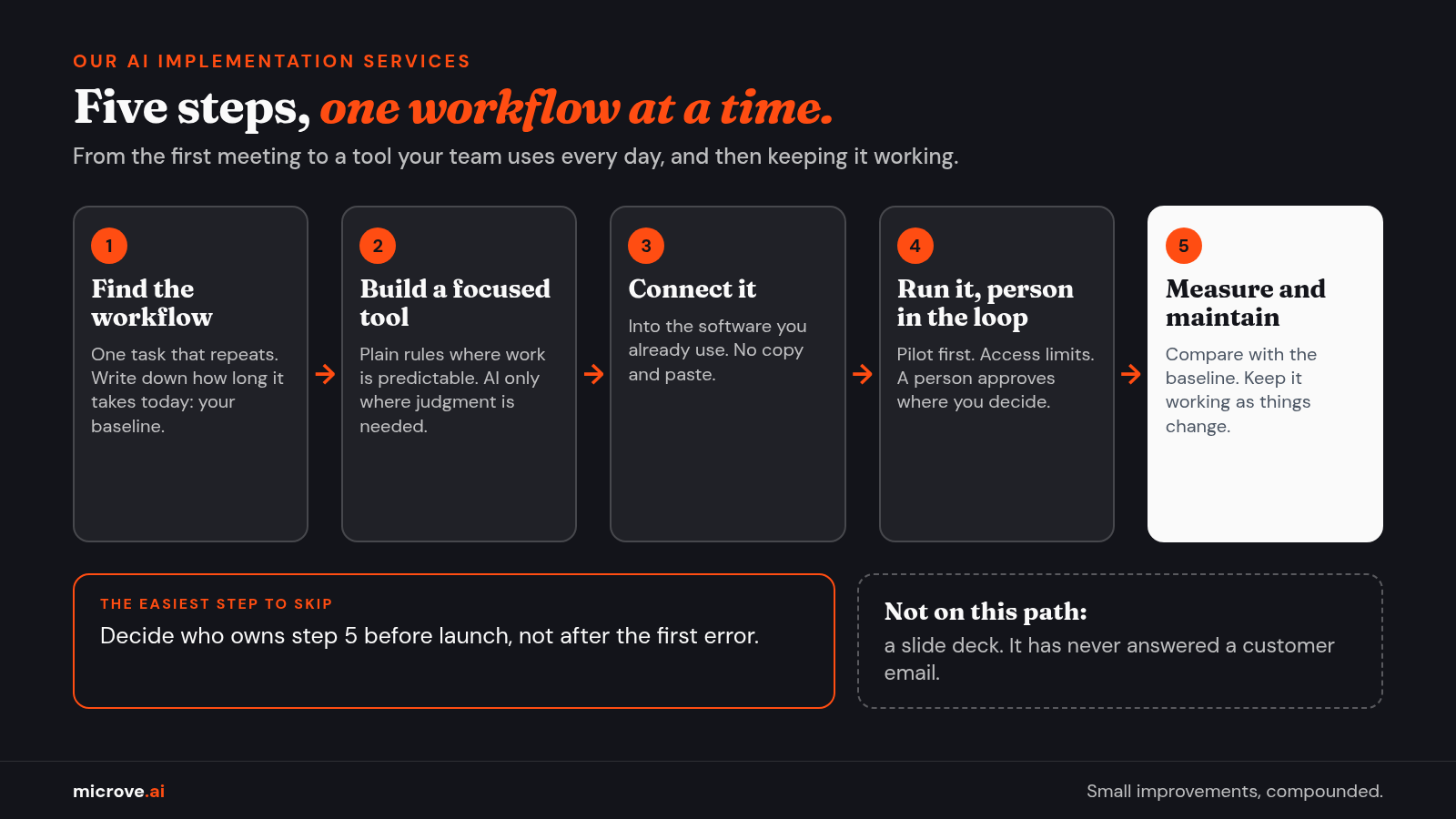
Our AI implementation services: five steps
One workflow at a time. From the first meeting to a tool your team uses every day, and then keeping it working.
- Find the workflow. We sit with the people who do the task and pick one that repeats and eats hours. We record how long it takes today: your baseline.
- Build a focused tool. We use plain rules for the predictable parts and AI only where a step needs judgment.
- Connect it. The tool reads from and writes to the software you already use, so nobody copies and pastes.
- Run it with a person in the loop. We start with a pilot, a small trial with a few users, and set access limits: what the tool may read and do. We decide with you where a person approves, such as before a message goes to a customer.
- Measure and maintain. We compare the result with the baseline. After launch, we keep the tool working on an optional monthly maintenance plan, or your own team takes it over. Decide who owns this before launch.
Checking does not stop at launch. The NIST AI Risk Management Framework (January 2023, voluntary) calls for AI systems to be "monitored when in production," which means in real, daily use. For each step in detail, read the five steps explained.
New to some of these words? AI terms in plain English explains pilot, production, human in the loop and more.
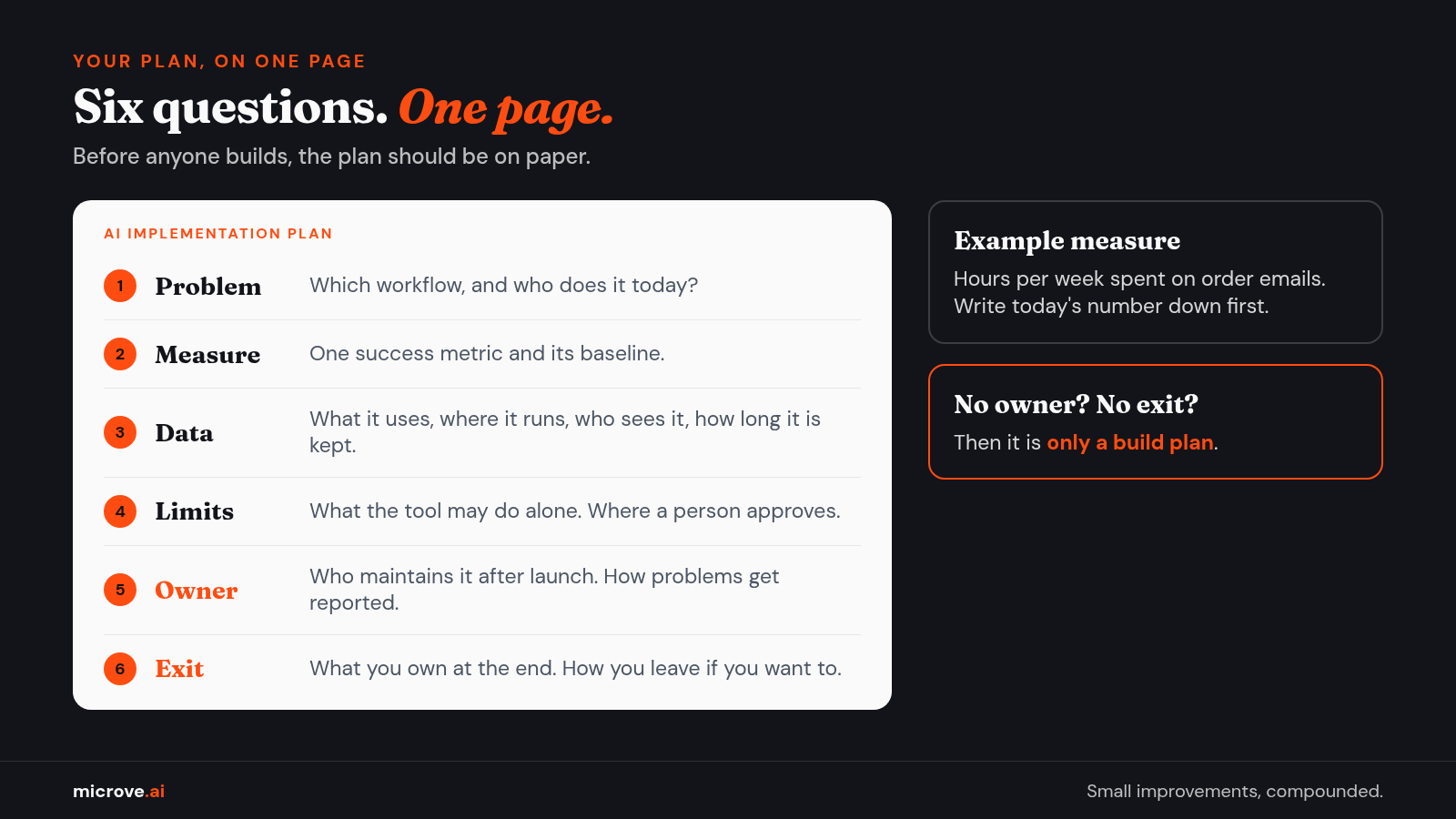
Your AI implementation plan, on one page
Before any build, the plan should fit on one page. It names the workflow, one success measure with today's number (for example, hours per week on order emails), the data the tool uses, where a person approves, who maintains it and how you leave. Without an owner and an exit, it is only a build plan.
What should the first month of work produce? See what AI consulting should deliver in the first 30 days. Comparing providers? Before you sign: where will our AI run? lists twelve questions to ask any AI provider, including us.
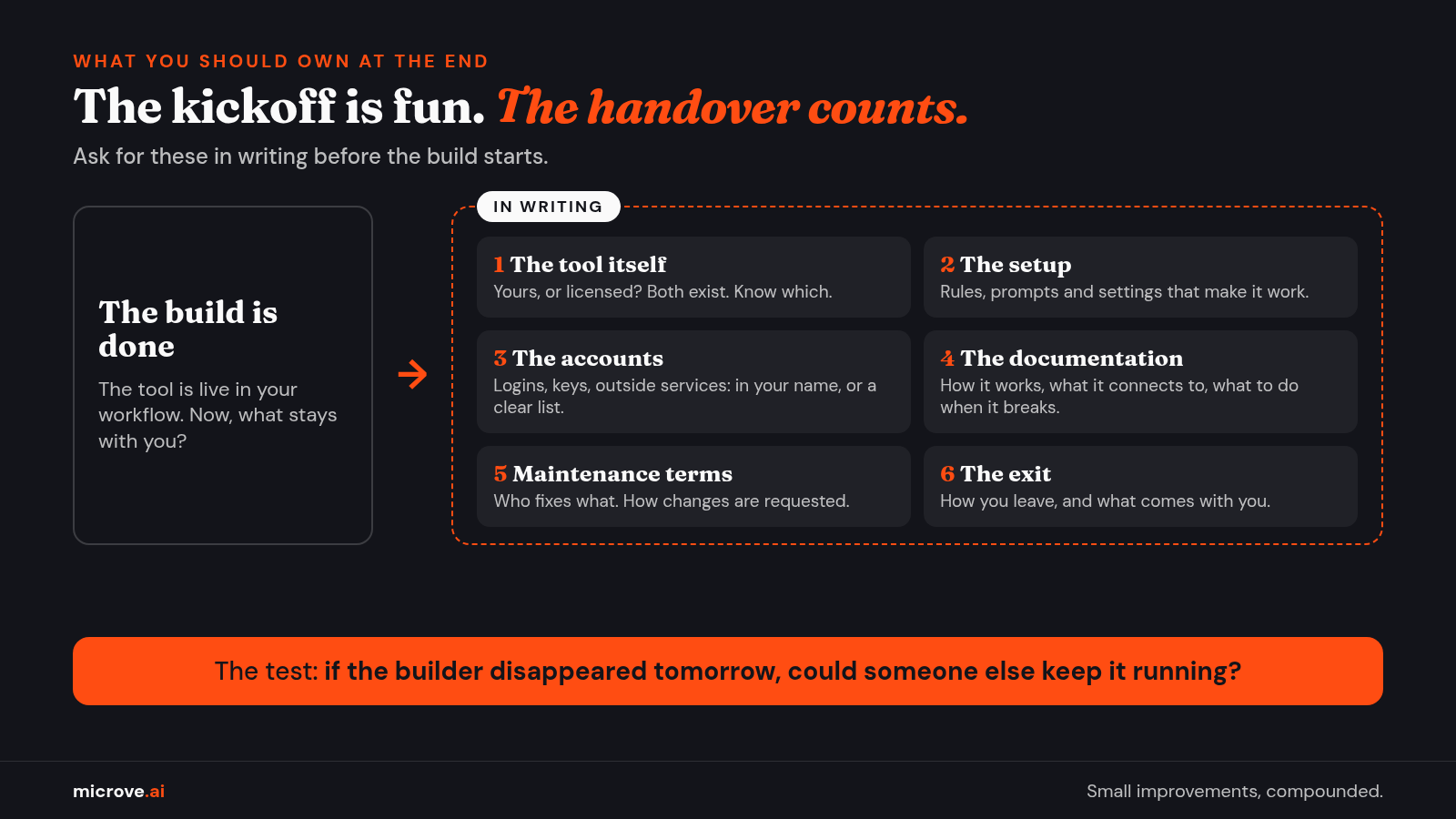
What you own at the end
Get the handover in writing before the build starts, so you know what you get at the end.
- The tool itself. When we build a custom tool, the client owns it. If we adapt one of our own products for you, you get a license to it. Both exist, so know which one you are buying.
- Everything that runs it. The setup, the accounts and the documentation, in your company's name or on a clear list.
- The terms. Who maintains what, and how you leave with what is yours.
How working with us starts
- Free consultation. One to three meetings. We talk through the workflow you have in mind.
- Optional scoping. If you decide to move forward, an optional paid scoping engagement follows and ends in a build proposal. Then you decide.
- Build. If you go ahead, scope and terms are in writing. The timeline depends on the scope, and you get regular progress updates.
- Maintenance, if you want it. Ongoing maintenance is an optional monthly plan.
Questions about hiring an AI implementation consultant
Do I need an AI consultant? Not always. Some problems need a simple automation or a setting in a tool you already have, not AI. If you don't need AI, we'll tell you.
Do you work with small businesses? Yes. We work with small, medium and enterprise businesses. If you searched for a small business AI consultant, the steps are the same. The scope is smaller: one workflow, a few users, a clear measure.
What happens in the free consultation? We meet one to three times. You show us where work piles up and which tools your team uses, and we tell you where AI can help and where it can't. If you want to go further, the next step is an optional paid scoping engagement that ends in a build proposal. You decide.
How much does AI implementation cost? It depends on the work: how many steps the workflow has, how many of your tools it must connect to, and how clean your data is. There is an implementation cost, plus a maintenance cost if it applies, both based on what the project needs. The consultation is free. The optional paid scoping engagement ends in a build proposal, so you see the build cost before any build starts.
How long does it take to implement AI? The build timeline depends on scope. You get regular progress updates.
How do I create an AI implementation plan? Start with one workflow and answer six questions on one page: the problem, the measure, the data, the limits, the owner and the exit. The plan section above lists each one.
What questions should I ask an AI consultant before I hire one? Ask what you will own at the end, who maintains the tool, how success is measured and how you leave. Get the answers in writing before the build starts.
How is an AI implementation partner different from an AI consultant? The words overlap. In general, an AI consultant advises on where AI fits, and an AI implementation partner builds the tool and puts it to work. We do the advice and the build, end to end: find the workflow, build the tool, connect it, run it and keep it working.
Who owns the AI system after it is built, and who maintains it? When we build a custom tool, the client owns it. Ongoing maintenance is an optional monthly plan.
Do you use AI for every step? No. Plain rules where the work is predictable, AI only where judgment is needed. How we choose between rules and AI shows the difference.
Do you build AI agents? Yes, when the workflow needs one. An AI agent is an AI tool that takes actions, not only answers. Before an agent touches your systems, we decide what it may read, what it may change and who approves the rest. More in AI agents for business: set access limits first.
Start with one workflow
If you don't need AI, we'll tell you. If you do, we start with one workflow and build from there.